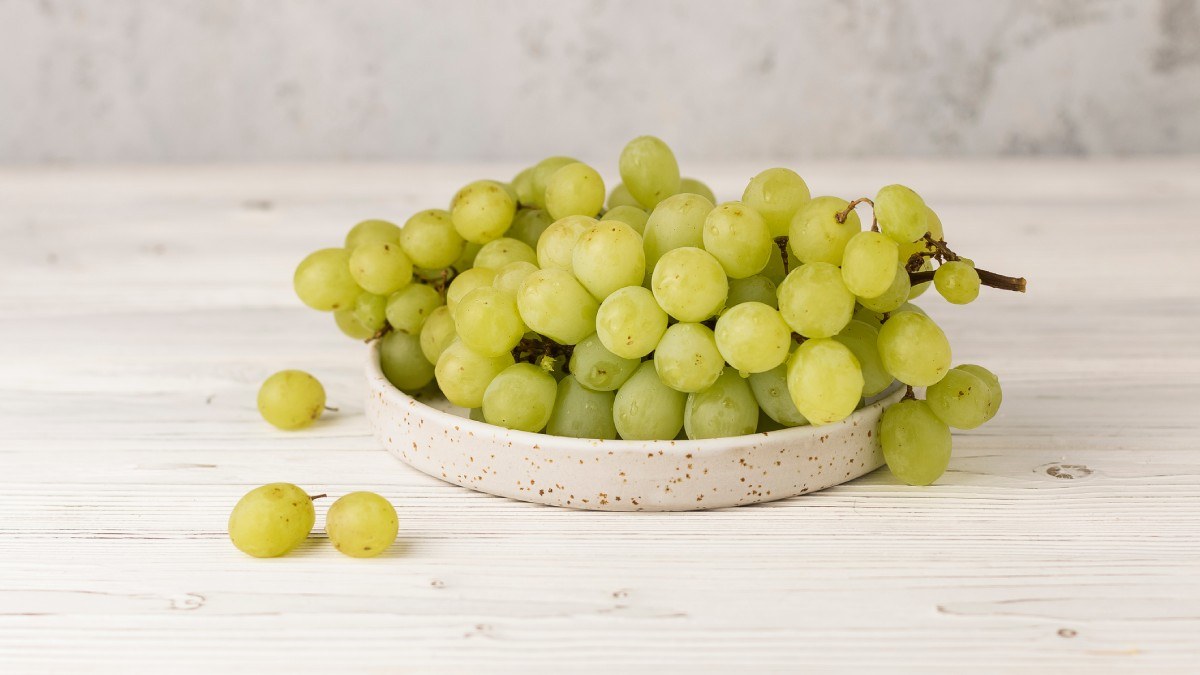
You bring home a beautiful bunch from the market on Saturday, and by Tuesday a few grapes have softened, followed by a grayish bloom that has won the heart of the bunch. Grapes are among the most fragile fruits at the start of the season.
Table grape producers nonetheless manage to keep it intact for much longer. Their method rests on a few simple steps: do not wash it, leave it on the bunch, remove the damaged berries, and place it in true cold, dry storage.
Why do grapes rot so quickly?
The main culprit goes by one name: Botrytis cinerea, the gray mold fungus. According to the postharvest research center at the University of California, Davis, it is the most destructive disease of table grapes after harvest, for two reasons. It continues to develop even around -0.5 °C, and it spreads from one berry to the next.
Concretely, a single split or crushed berry in the middle of the cluster becomes a focal point. The fungus darkens the skin and makes it slide, then white filaments pierce the surface, before a mass of gray spores appears and spreads to neighboring berries. Water makes the job easier: UC Davis researchers note that in humid conditions the fungus does not even need a wound to establish itself. It is the same mechanism that causes strawberries to mold in a matter of days.
Grapes, however, have their own protection: bloom, that fine whitish film that dulls the berries. It is not dirt, but a natural waxy layer that protects the fruit. California producers remind that rough handling is enough to erase it and degrade grape quality.
What table-grape growers do
In France, the Moissac chasselatiers, in Tarn-et-Garonne and Lot, work according to one of the most precise set of rules in the sector. The AOP Chasselas de Moissac standard reads almost like a manual for conservation.
The grapes selected from the vine are healthy, ripe, and free of moisture traces.
After picking comes the trimming. In the workshop, trimming shears remove one by one, with small pointed scissors, the damaged berries from each cluster. For grapes destined for long storage, the regulation requires removing at harvest the botrytis-affected berries, then placing the clusters in a single layer, the stem end up, in containers that preserve the bloom. They are then sent to a cold room whose temperature and humidity are controlled.
In California, professionals maintain their storage rooms between -1 and 0 °C, with 90 to 95% relative humidity and moderate air circulation, to prevent the rachis (the stalk of the cluster) from drying out.
The method to reproduce at home
It is impossible to recreate a professional cold room in your kitchen, but the same principles apply very well at home.
- Do not wash it before storing. Keep the bloom intact, handle the bunch by the rachis, and rinse only the portion you will eat, just before tasting.
- Leave the berries on the bunch. A berry detached from its stem dehydrates more quickly.
- Do your own trimming. As soon as you get home, inspect the bunch, including its center, and remove with small scissors any split, crushed, soft, or stained berries.
- Choose an airy box. Place the bunches on a sheet of paper towels, not stacked, in a non-hermetic box or one with a few holes. The paper absorbs moisture, and the ventilation prevents buildup.
- Target true cold, between 0 and 4 °C, and keep the box away from onions, garlic, and leeks: grapes easily absorb odors.
This last point often surprises people: the vegetable drawer isn’t necessarily the best spot. According to an INRAE guide, it hovers around 6 to 8 °C, while the fridge’s cold zone sits between 0 and 4 °C. Yet grapes tolerate low temperatures well, since professionals store them around 0 °C. Find the cold zone indicated by your manual or a pictogram, and store your box there.
The three mistakes that accelerate spoilage
- Rinsing in advance. This is the most common and most counterproductive reflex: water remains trapped between tightly packed berries, removes part of the bloom, and gives the fungus exactly the humidity it needs.
- A closed plastic bag. Grapes keep breathing after harvest and release moisture. In a closed bag, that moisture condenses on the berries. It’s no accident that professionals package their clusters in perforated films.
- A fruit bowl in the sun. Beautifully displayed on the table, grapes soften and deteriorate much faster than in the cold. They may last for a meal, not several days.
How long can it really last?
With these steps, a grape bought very fresh generally keeps for one to two weeks in the refrigerator, sometimes a bit longer. It all depends on its initial state: a green and pliant rachis, with firm and well-attached berries, are good signs. A brown and brittle rachis signals a cluster that will store poorly.
Industrial stores lasting several months rely on cold rooms calibrated to half-degree precision and on sulfur dioxide treatments, which are impossible to reproduce at home.
An old technique, however, long outperformed our refrigerators. In 1848, in Thomery, in Seine-et-Marne, it was discovered by chance that a Chasselas cluster picked with a piece of vine shoot dipped in water stayed fresh for months. Viticulturists drew from this the “raisin rooms”: cool, dark chambers where the clusters, suspended from small bottles filled with water and a piece of charcoal, were preserved from October to May. Thanks to this method, Île-de-France producers still supplied the Paris market with fresh grapes in March.
Source: ucanr.edu
