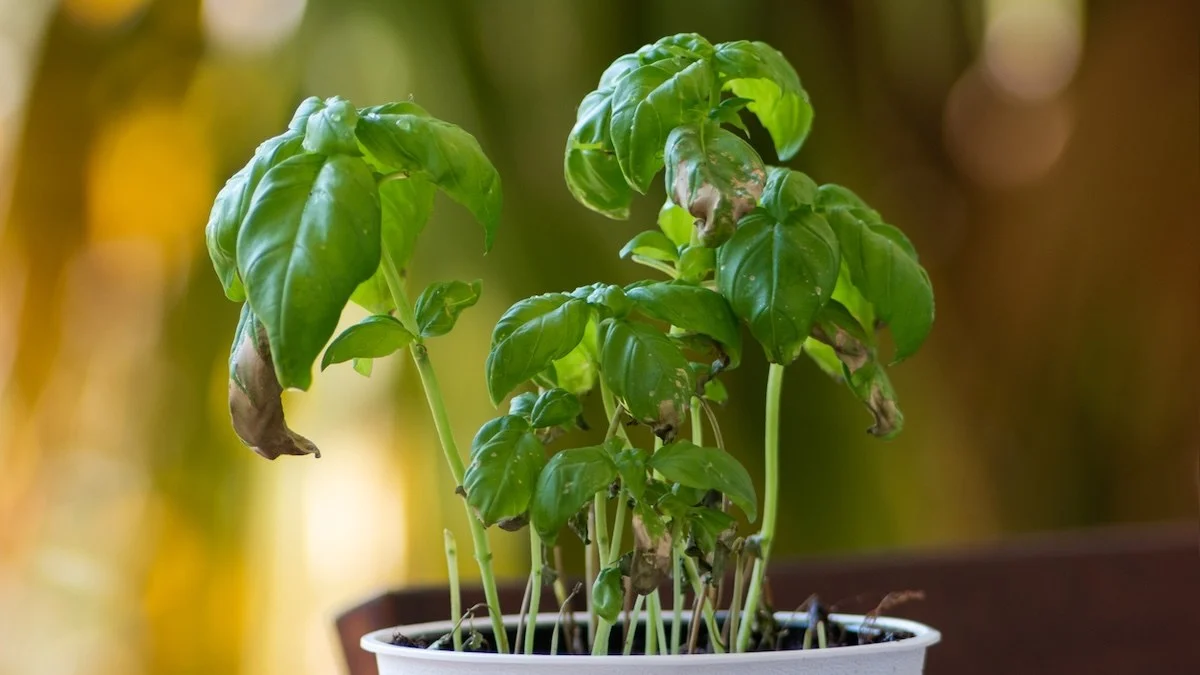
Pesto has one flaw that is rarely forgiven: it requires fresh, vividly green basil in quantity. But what to do when what we have left are tired herbs, half-wilting, that we deem too sad to end up on a plate? The starred chef Thibaut Spiwack, involved in addressing food waste, proposes a clever alternative: an herb oil, which captures the pesto’s spirit (intensity, color, taste) without its constraints. “Parsley, cilantro, basil, chervil… even a little wilted, they can still become an ultra-fragrant herb oil. It’s simple, beautiful, zero-waste and it’s going to add a lot of flavor to your plates this summer“, the chef explains in a video posted on Instagram. We’re sharing with you his entire method, very easy and quick to redo at home!
The common ground (and the difference) with pesto
Pesto rests on a simple principle: concentrate the flavor of a fresh herb in a fatty base, with pine nuts, Parmesan and garlic as extras. The wilted herb oil goes straight to the essentials and frees itself from any additions. No cheese, no nuts, no garlic. Just herbs and a neutral oil. The result? A preparation that is much lighter, quicker to make, and that does not require ingredients at the peak of freshness to succeed. Where pesto needs a good basil, this oil is satisfied with herbs that would, under normal circumstances, have been tossed in the trash.
Why wilted herbs work perfectly
A wilted herb has not lost any of its flavor. What changes is only the turgor of its cells, now water-depleted, and not the presence of the aromatic compounds it contains. This is precisely what allows you to treat softened parsley or yellowed cilantro as you would treat a beautiful bouquet of basil for a classic pesto!
The method, designed as a quick pesto
All recoverable herbs, including stems (indeed, these are often the most concentrated in taste), are blended with a neutral oil. Opt for a sunflower or canola oil rather than olive oil, whose pronounced flavor would overpower. The mixture is then worked until it becomes very smooth and a deep green, then it is filtered through a fine cloth or coffee filter to keep only the liquid. No resting time, no cooking: in just a few minutes, you obtain a liquid equivalent of pesto, to be stored in the fridge for several days.
Where herb oil truly replaces pesto
It is in its uses that this alternative makes its full sense. A drizzle over hot pasta, in a cold pasta salad, on a pizza fresh from the oven, on burrata or mozzarella, or as a seasoning for a risotto… Herb oil also lends itself to uses where pesto is rarely invited, such as grilled fish, a gazpacho, or a purée. It will perfectly season meat or roasted vegetables! In short, herb oil finds its place in (almost) all of your plates.
Mistakes that ruin the recipe
Even though the recipe is truly simple, be careful to follow a few steps so you don’t spoil everything.
– Use a perfumed oil : it would crush the herbs instead of revealing them, and we would be far from the aromatic richness of pesto.
– Too short blending : if you don’t blend long enough, you’ll get a coarse texture, far from the creaminess sought.
– Neglect the filtration : never skip this step, it prevents the oil from becoming cloudy and unpleasant on the palate.
– Storing at room temperature : unlike a regular oil, this preparation keeps in the fridge for a few days.
Herb oil: what to remember
You’ve understood it: there’s no need for impeccable basil or pine nuts to capture the spirit of a good pesto. This wilted herb oil, blended then filtered, offers the same aromatic intensity with ingredients that would almost certainly have ended up in the trash. This tip from star chef Thibaut Spiwack could well become your must-have this summer!
View this post on InstagramA post shared by Thibaut Spiwack (@thibautspiwack)
