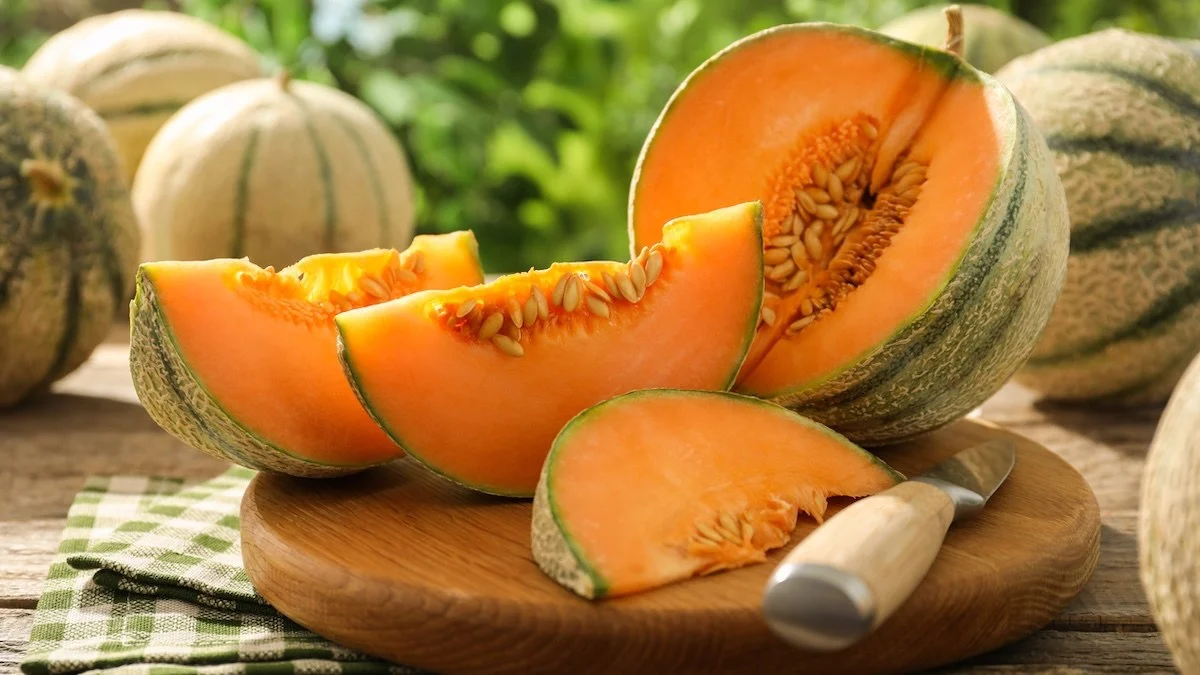
No more bland melons, too green (or too ripe) that end up in the trash! Whether you’re at the market or the supermarket, a few simple steps are enough to spot THE perfect melon, the one that will be juicy, sweet, and fragrant. We’ve gathered the tips that growers and greengrocers use daily to never go wrong, as well as the most common mistakes to avoid.
Tip #1: the peduncle, your best clue
The first reflex of professionals is to look at the peduncle, the small stem where the melon was attached to the plant. If it is clearly detached or cracked in a star around the stem, that’s a good sign. The fruit has then reached maturity naturally before harvest. Conversely, a peduncle that is still very green and firmly attached often signals a harvest that was too early and thus a melon that will be less sweet.
This detail is, by the way, the one that farmers look at first, even before weighing the fruit. In markets, some producers go so far as to sort their melons according to this single criterion before displaying them. A melon picked too early will never fully recover its lack of sugar, even if left to ripen on the worktop, as sugar develops mainly on the plant and not after harvest.
Tip #2: the crackling, signature of a good melon
On a Charentais melon, observe the network of small crackles present on the rind, especially around the peduncle. The more marked and numerous they are, the longer the fruit has likely been exposed to the sun as it ripened. It is a good indicator of sugar content, far more reliable than the color of the skin, which can vary depending on the variety of melon.
Many people wrongly rely solely on the shade of the rind, more orange or paler, thinking it indicates the degree of maturity. This is actually a red herring: two melons of the same variety, harvested on the same day, may have slightly different colors depending on sun exposure during growth. The crackling, on the other hand, does not lie since it results directly from the growth of the flesh beneath the rind.
Tip #3: the weight, don’t rely on size alone
A good melon should feel heavy for its size. This is a trick that farmers repeat endlessly! Take two melons of identical size and weigh them, one in each hand if possible: the one that feels the most dense generally contains more water and sugar (hence more juice). A melon that is too light for its size may be hollow or lack flesh.
This test is particularly effective in supermarkets where melons are often sorted more by size class than by actual weight. Two fruits can look alike to the naked eye and yet show a surprising weight difference once in hand (or on the scale). Get into the habit of systematically comparing several melons before making your choice—it’s a simple reflex that takes only a few seconds.
Tip #4: the aroma, the test that never lies
Bring the melon up to your nose on the side of the peduncle and inhale. A ripe melon gives off a sweet and pronounced fragrance, almost intoxicating, as soon as it approaches the nose. If you don’t smell anything, it’s probably not ready to be tasted yet. If the smell is too strong, almost fermented, it is probably already overripe.
This is often the most reliable and quickest test to perform to select THE right melon. Professionals advise doing it last, after you have already ruled out fruits that fail the weight and peduncle tests, to refine your choice.
Tip #5: pressure at the summit, the gesture of connoisseurs
Gently press with the thumb on the opposite side of the peduncle, on the part called “the flower.” If you feel a very slight give, it’s a sign that the melon is ready. If it is completely hard, it will need a few more days of ripening at room temperature.
This gesture takes a bit of practice to properly sense the nuance between “still firm” and “ripe.” Do not hesitate to compare several melons side by side to fine-tune your sense. With practice, the difference will become increasingly obvious!
Mistakes to avoid
Even with the right gestures, certain habits can spoil a good melon before you even taste it.
Putting it in the fridge too early
Many people store their melon in the fridge as soon as they buy it, thinking they’re doing the right thing. But that’s a big mistake! The cold stops the ripening process abruptly, and an unripe melon placed in the fridge will stay bland even after several days.
Relying solely on color
As mentioned above, the rind color is not a reliable guarantee of perfect ripeness. If you base your choice on this criterion alone, you risk ending up with a disappointing fruit.
Pushing too hard to test firmness
Pushing a melon with force to “be sure” is totally counterproductive. You will damage the flesh at the test site, which will accelerate rot there, even if the fruit is still good.
Cutting it immediately after purchase
If the melon is not yet fully ripe, cutting it too soon prevents you from enjoying its full potential. It’s better to wait a few days at room temperature than to rush. It would be a shame to waste a melon for nothing…
Storing cut melon for too long
Once opened, a melon quickly loses flavor and texture. It is best to consume it within two days of cutting. Store it in plastic wrap, or in an airtight container, in the refrigerator.
From now on, you have all the keys to always choose a well-ripe and sweet melon to treat yourself this summer!
