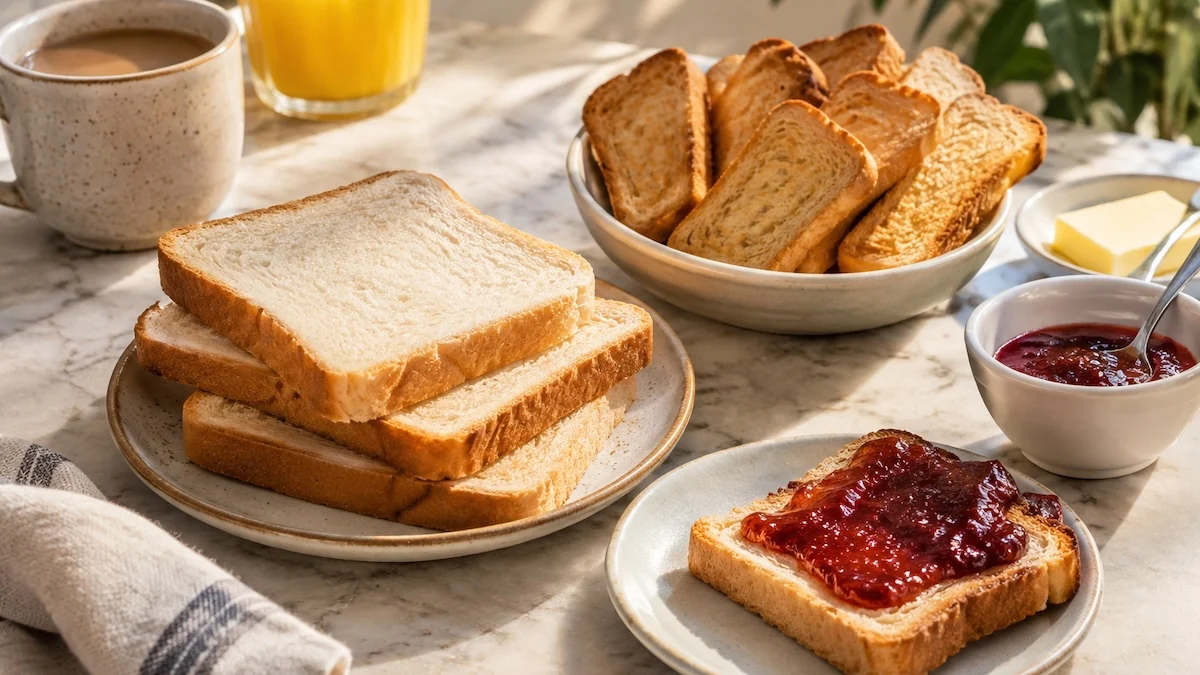
Breakfast, an (almost) universal ritual in France
The first meal of the day remains an almost indispensable appointment: about 90% of children and adults have one every day. And on the table, bakery products occupy a central place! About 75% of the population consume them daily.
At breakfast, they appear in 30% of children’s meals and in 50% of adults’ meals. In other words, one adult breakfast out of two includes sliced sandwich bread, rusks, or toasted bread. Over the course of the day, the frequency of consumption of these same products averages to one per day for children and one and a half per day for adults.
Sliced bread, rusks, toast: who eats what and in what quantity?
Behind the term “bakery,” there are everyday products sold in stores. Plain sandwich bread, seeded or whole-grain, rusks made of wheat or buckwheat, small toasted breads, Swedish-style toasted breads, crispy slices… The range is broader than you might think!
In terms of quantities, the figures stay modest. Children consume on average 50 g per day, about two slices of sandwich bread. Adults, on the other hand, consume on average 80 g per day, the equivalent of about three slices of sandwich bread.
These products also have their history. By the way, did you know that the rusk originated in 1902? It was baker Henri Heudebert who had the idea of baking bread slices twice, after seeing his mother toast them on the end of a fork in the fireplace!
What these products bring to energy first thing in the morning
Breakfast provides on average 365 kcal, or about 20% of daily energy intake. Within this, the share of bakery products remains reasonable: for children, it represents about 12% of breakfast energy (roughly 43 kcal); for adults, it’s about 23% (roughly 82 kcal).
Generally, it is recommended at breakfast to have a cereal product (preferably whole-grain), a fruit (ideally fresh and seasonal), a dairy product, and an unsweetened beverage. (1)
On average, breakfast should account for 20 to 25% of total energy intake. (2)
The real strength: fiber
This is perhaps the most interesting figure when talking about bakery products! Taken at breakfast (or at other times of the day), these products contribute significantly to daily fiber intake. For children, it is about 10.6% of fiber intake (for 50 g) and for adults, the share is about 17.7% (for 80 g).
According to the Nutrimétrie categorization (3), bakery products are the 2nd category of foods that contribute to fiber intake in children and the 1st in adults. And for a consumption of a few slices per day, their role is far from negligible! The range includes complete versions, those with cereals, or those with seeds to vary the pleasures.
And for the snack, what do we eat? A quick detour through biscuits and cakes
While sliced bread and rusks are the morning stars, biscuits and cakes take over at 4 p.m.! About 84% of children and 55% of adults have a snack. During this sacred moment, about 12% of biscuits and cakes are consumed (i.e., 6% of the total amount consumed at snack time). Chocolate cakes, madeleines, shortbreads, galettes, Breton palets, cookies… you will not be short of choices!
As for sugars, their share remains limited: about 4 g per snack, or 16% of the sugars provided by the snack. Again, it’s all about quantity and frequency (twice a week for children, one and a half times for adults).
Between the breakfast taken daily by nine out of ten French people and bakery products present in one adult’s breakfast out of two, the conclusion is clear: these products are truly embedded in our habits, generation after generation. Their contribution to morning energy remains measured, while they count among the main sources of fiber in the diet, especially for older individuals. Like all “pleasure” products, they undoubtedly have their place in a varied and balanced diet; it’s all about the quantity!
(1) Source: Santé publique France, Manger Bouger 2026, How to pace your day around 3 meals?
(2) Source: Ministry of National Education, Small breakfasts in schools to promote equal opportunities
(3) Perimeter of the Nutrimétrie study: Consumption of biscuits, cakes and bakery products in France in 2024, 2000 adults and 1000 children, collected over 3 independent days (2 weekdays and 1 weekend day)
(4) Source: Santé publique France, Manger Bouger 2026, Discover snack ideas
