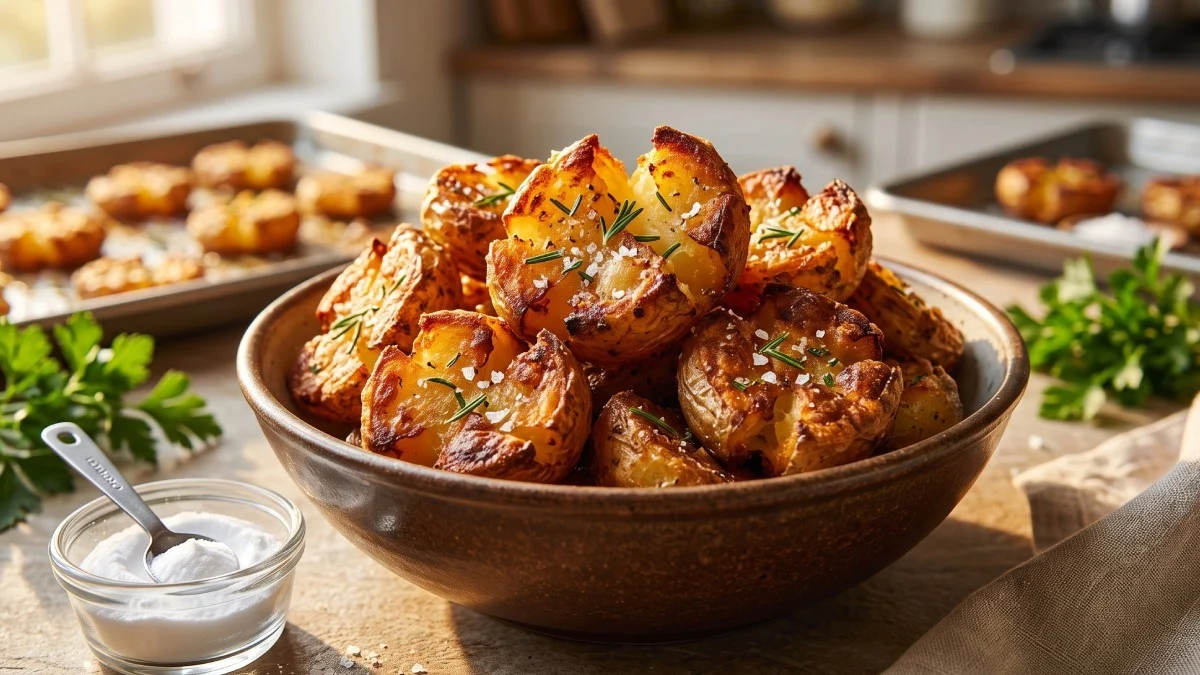
When potatoes come out of the oven with a soft surface despite a nice browning, a small addition to the pre-cooking water can help achieve the crispy crust they lack.
You cut them, seasoned them and baked them hoping to regain that contrast between a golden crust and a molten center. Yet when serving, they look more like potatoes simply cooked than like the ones you imagined. Before adding more oil or extending the cooking time, one step deserves your attention: their passage through water.
The ingredient to use is food-grade baking soda. A small amount added to the pre-cooking water helps to soften the surface of the pieces. This trick prepares the ground for roasting, provided you drain the potatoes well and give them enough space on the sheet.
Why this small addition helps to obtain a crispy crust
The baking soda makes the water more alkaline, which promotes the breakdown of the surface of the potatoes. It becomes softer and more easily develops a thin layer of starch when the pieces are stirred. Chef José Pizarro also recommends this addition in his tips published by Good Food. The aim is to prepare an exterior that will then crisp up during roasting.
The variety also matters. For this preparation, choose starchy potatoes, suitable for mashed potatoes or oven cooking. They allow for a soft interior and a surface that flakes slightly after pre-cooking. On the package, usage indications will help you choose. Keep generous and even pieces: small cubes could fall apart before you can bake them.
The ingredients to plan for four people
This version requires few ingredients and can accompany roasted meat, fish or a plate of vegetables. Plan about 1 kg of potatoes and a large baking sheet. The measured amount is half a level teaspoon of food-grade baking soda per 2 liters of water, a benchmark used in J. Kenji López-Alt’s method published on Serious Eats.
Be sure to use food-grade baking soda and measure it before you start. A heaping spoonful will not yield a better result. For seasoning, start with a simple base of olive oil, salt, and pepper. You can add herbs at serving time, once the desired texture is achieved.
- 1 kg of starchy potatoes
- 2 liters of water for pre-cooking
- 1/2 teaspoon level of food-grade baking soda
- 3 tablespoons olive oil
- Salt for the cooking water and for seasoning
- Pepper
- Parsley or chives to serve, depending on your preferences
The pre-cooking that prepares the surface of the potatoes
Peel the potatoes and cut them into large pieces of roughly equal size. Bring the 2 liters of water to a boil in a pot large enough, then add salt and baking soda. Submerge the pieces in the water and let them simmer for about 10 minutes after the water returns to a boil. Check with the tip of a knife: it should penetrate easily, while the pieces remain firm enough to handle.
Drain carefully, then let the steam escape for a few minutes. Put the potatoes back in the empty pot and shake gently to roughen the edges. This move is also used by Jamie Oliver for his roasted potatoes. Stop when the edges become slightly floury: you should keep the pieces, not turn them into puree.
A hot oven and space to brown them
Preheat the oven to 200 °C with convection. Coat the potatoes with olive oil, then spread them on a large baking sheet in a single layer. Leave space between the pieces, even if you need to use two sheets. Tom Kerridge emphasizes this point in his tips for successful roasted potatoes: when crowded, they steam more and don’t crisp as well.
Count on about 50 to 60 minutes in the oven. Wait about twenty minutes before turning the pieces with a spatula, then monitor their color and turn them again if necessary. The time is indicative: remove them when several faces are golden and the exterior forms a crust. With peeling, pre-cooking and roasting, plan about 1 h 15 to 1 h 30 in total.
How to keep the crisp until serving
Organize the meal so that the potatoes finish cooking just before they go to the table. Avoid sealing them still steaming under a lid: the trapped moisture would soften their surface. Instead, prepare the serving dish, the herbs, and the other elements of the meal while they brown. You can then season them and bring them directly to the table.
To vary, add chopped parsley, chives, or a little lemon zest at the last moment. A yogurt sauce can be offered on the side, so that each person can help themselves without soaking the whole sheet. On the next attempt, keep the same quantities and watch especially the surface before baking: well-drained and slightly rough, it is ready to form the crust you are seeking.
