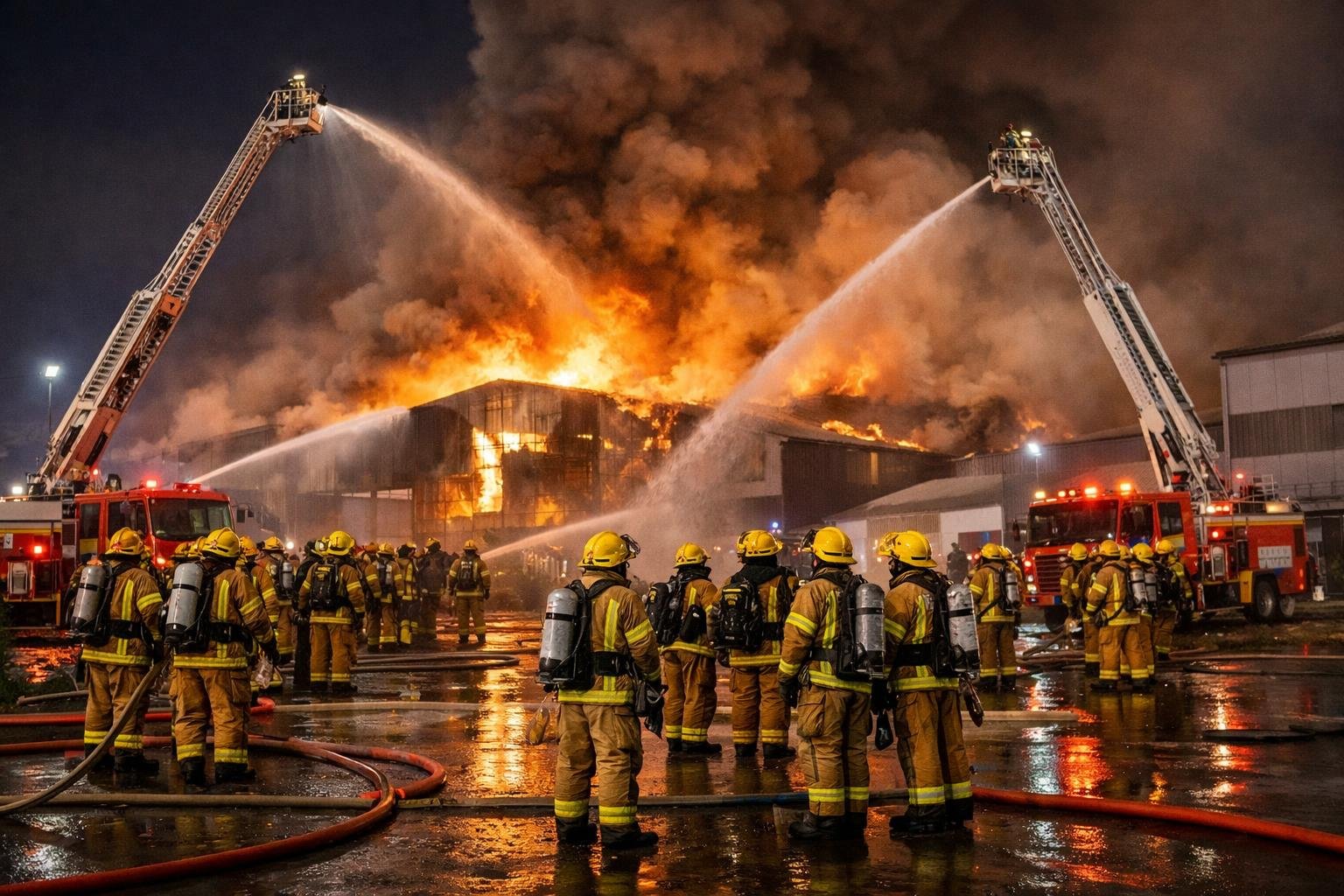
An orange glow pulsed over Christchurch’s industrial belt overnight as a fierce warehouse blaze forced emergency crews into a fast, methodical fight. More than forty firefighters worked in rotation through the small hours, pushing back heat, smoke, and uncertainty in a district where every roller door hides a different risk.
What happened overnight
Shortly after midnight, alarms tripped and callers reported thick, drifting smoke from a commercial block on the city’s western fringe. When the first appliances arrived, they found a single-storey warehouse with heavy fire showing at the rear and heat radiating across the yard.
“It was a deep-seated fire in a high-bay space,” said a Fire and Emergency New Zealand spokesperson. “Our priority was to stop lateral spread to adjacent tenancies and protect exposures.”
Crews established cordons as a precaution. Several neighboring businesses were cleared, and traffic diversions were laid down on approach roads to keep the scene workable. By dawn, the fire was largely contained, though hotspots simmered in roof voids and stacked inventory.
How crews fought the blaze
The response scaled quickly. Multiple pumps, a ladder platform, and specialist support units converged to create a tight, layered perimeter around the structure. Command split the scene into sectors—front entry, rear loading bays, and a roof sector managed from the aerial platform—so teams could operate in parallel without crossing hose lines.
Inside, firefighters tackled a labyrinth of racks and pallets, where flame runs can hide behind sheeted partitions and high shelving. Outside, the aerial monitor punched water into the roofline to cool steel framing and knock down convection columns feeding the plume.
“Industrial fires are about momentum,” a sector leader said. “You move fast enough to get ahead of the fire, but slow enough to stay safe around unknown hazardous materials.”
Impact on businesses and residents
People living downwind were asked to keep windows shut as a precaution against smoke and particulates. Some workers arriving for early shifts found their streets blocked and their sites taped off. Business owners stood on verges, watching flashlights flicker inside the structure and counting the minutes.
By early morning, officials reported no serious injuries. Paramedics assessed a handful of people for mild smoke exposure, and one firefighter was checked for heat stress and cleared.
The warehouse itself suffered significant smoke damage, scorching across a loading zone, and localized roof compromise where heat pooled under the eaves. Adjacent properties showed only minor effects—principally soot deposition on exterior cladding—thanks to effective exposure protection.
What investigators will look for
Once the last steam curls away, the quiet part begins. Fire origin-and-cause specialists will map burn patterns, examine electrical runs, and review CCTV timelines. Palletized goods, battery storage, and charging stations—common in logistics spaces—draw particular attention because they can accelerate ignition or complicate suppression.
“We’ll be checking for any energized equipment left on, signs of mechanical failure, and the arrangement of stock,” the spokesperson added. “Stack height, aisle width, and separation from ignition sources make a difference.”
Early indications suggest no widespread release of chemicals, but environmental teams will still sample run-off and nearby drains. Insurance assessors and structural engineers will follow, testing the building’s steel for heat deformation and checking slab integrity where prolonged cooling water pooled.
One list you actually need
- If you live or work nearby: keep doors and windows closed, switch off HVAC until air clears, avoid cordoned routes, follow official updates from Fire and Emergency and the council, and seek medical advice if you experience breathing difficulties, eye irritation, or persistent cough.
By the numbers
- 40+ firefighters at peak
- Multiple pump appliances, one aerial platform, and support units
- Several businesses evacuated as a precaution
- Containment achieved before sunrise; dampening-down continued into the morning
How this fire stacks up
| Aspect | This event | Typical warehouse fires |
|---|---|---|
| Crew size | 40+ firefighters, multi-appliance response | 20–30 for moderate incidents |
| Duration to contain | Overnight into early morning | 3–8 hours, depending on fuel load |
| Evacuations | Nearby businesses cleared | Often limited to immediate neighbors |
| Hazardous materials | Assessed; no major release indicated | Common risk, variable by tenant mix |
| Structural impact | Localized roof and interior rack damage | Ranges from smoke-only to partial collapse |
| Injuries | None serious reported | Minor smoke inhalation typical |
Voices from the cordon
“I watched the sky go from dull grey to that bright, pulsing orange,” said a delivery driver who arrived before dawn. “Then the steam started, and you knew they were winning.”
“We went door-to-door on the block to advise people about the smoke,” an emergency responder noted. “The community was calm, cooperative, and that makes our job a lot safer.”
What comes next
Expect a staggered reopening of the surrounding streets once hotspots stop recurring and the aerial ladder demobilizes. Business owners will retrieve critical documents and servers when scene safety allows. Air-quality readings will determine how long to keep those windows shut.
For now, the overnight mission stands as a measured win: quick notification, disciplined sectoring, and aggressive exposure protection. In industrial firefighting, that combination turns a potential block-wide disaster into a single-building event—serious, smoky, and stressful, but ultimately held at the line.
