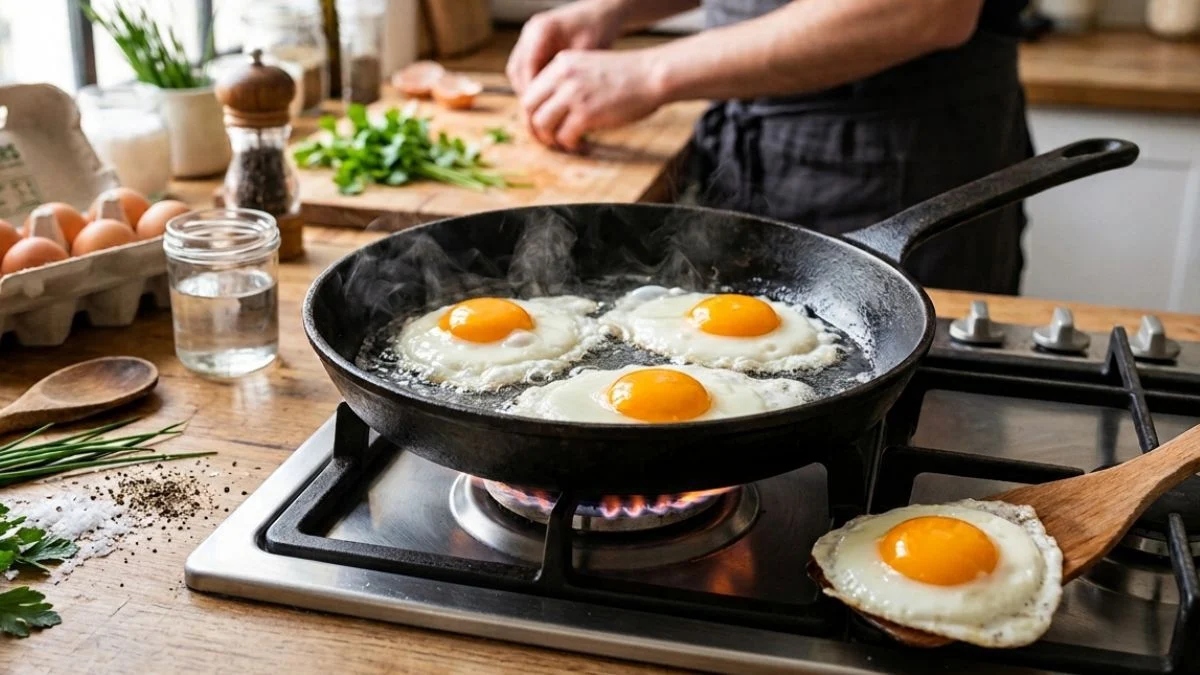
A hot pan, a sizzling egg, then a simple splash of water poured to the side before promptly closing the lid. That’s all this trick requires, and it has been circulating for months in the American culinary press and on social media: cooking fried eggs with no oil or butter, or almost. The idea is appealing because it promises a lighter, more even result, without having to flip the egg and without risking breaking the yolk. But is it really as simple as it’s presented?
- The principle: one to two teaspoons of water poured into the hot pan, then the lid closed immediately.
- The steam gently cooks the top of the white, without the need to flip the egg.
- In the version most commonly used by chefs, the technique does not completely remove butter or oil; it mainly reduces the amount.
- A fat-free version exists as well, but it clearly changes the taste and texture according to several professionals interviewed by the American press.
How this water trick is supposed to work
The technique has a name in English, the “steam bas ting,” which could be translated as assisted steaming. Nelson Serrano-Bahri, chef and Director of Innovation at the American Egg Board, the professional body representing egg producers in the United States, detailed it to The Takeout, a culinary media outlet. The principle rests on one teaspoon or two of water, poured into a corner of the pan and not directly onto the yolk, then the lid closed immediately to trap the steam.
A small splash of water creates steam, which then gently cooks the top of the egg, without the need to flip it.
According to him, this steam helps to uniformly set the white, including the delicate film that covers the yolk, while reducing the risk of piercing it. The claimed result: an egg with a texture close to that of a poached egg, with a yolk remaining runny, without ever turning the egg in the pan.
A technique already known to chefs, but not quite as it is presented
That is where the promise of a total replacement deserves nuance. In the method recommended by Nelson Serrano-Bahri, water is introduced once the egg has already started to cook in a little butter or oil, long enough for the edges to whiten. The water thus does not serve to replace the fat from the start, but to finish cooking the top without having to flip the egg or add more fat. Other American specialty sites, like MasterClass or The Cookful, describe exactly the same sequence: a bit of butter to prevent sticking, then water for the steam. The amount of fat used is significantly reduced, but it is not completely removed in this version, the one most common among professionals.
The fat-free version does not have unanimous support
There is, however, a more radical version, which went viral under the name “water frying”: cooking the egg solely in water, with not a single drop of oil or butter, in a non-stick pan. The Takeout interviewed Lisa Steele, a poultry farmer and culinary author, who is more reserved about this method. According to her, the egg loses the golden and crispy edges that come from cooking in oil, and the result is closer to a light poaching than to frying.
We could almost call that a shallow-poached egg.
Her other reservation concerns the taste: water, not imparting any flavor, yields an egg that is paler than one with butter or oil. She advises, for those who want to avoid fat while preserving flavor, to replace the water with broth, cream, or even a little wine. Another American culinary media outlet, The Kitchn, tested this hypothesis even more radically by cracking an egg into a cold non-stick pan, with no fat: the cooking did work, the egg didn’t stick, but the result was judged less rich in flavor. In other words, a good non-stick pan already does much of the work, with or without water.
How to test the technique at home
For the most reliable version, the one chefs recommend, heat a non-stick pan with a very small amount of butter or oil, over medium heat. Once the egg is cracked and the edges of the white begin to set, add one to two teaspoons of water next to the yolk, never on top of it, then cover immediately. Twenty to sixty seconds are usually enough for the film of white over the yolk to become opaque, a sign that the egg is ready. The longer the lid stays in place, the more the yolk firms up.
We had already cataloged several chef’s tricks for cooking eggs, and this one fits into the same logic: limiting fat without sacrificing texture. For those who want to go further and try the entirely fat-free version, it’s best to know in advance that the result will be closer to a poached egg than to a fried, golden yolk egg, with a more neutral taste.
