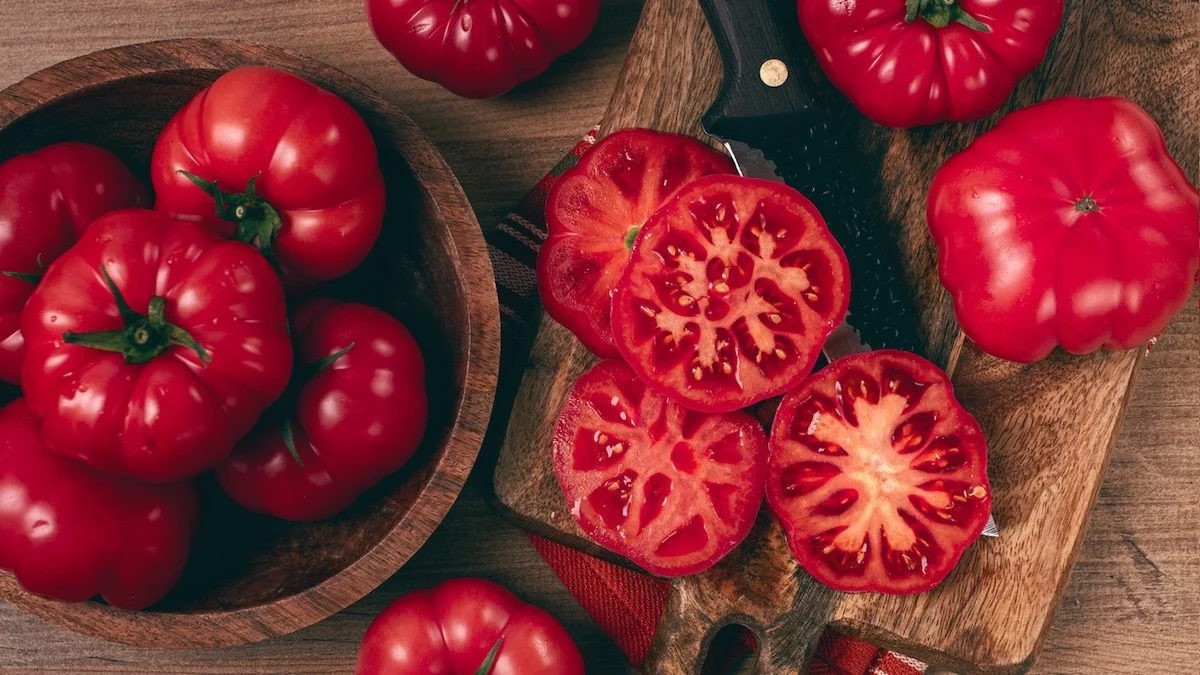
When the sunny days return in full force, we all have only one desire: to enjoy the peak tomato season. We stock up and, quite often, buy far too many. So to prevent the riper ones from ending up at the bottom of the vegetable drawer and being “wasted,” the starred chef Stéphanie Le Quellec offers a no-waste and gourmet alternative to use them before it’s too late. Her trick? A flavorful vinaigrette that will give a second life to your overripe tomatoes! The recipe is easy, quick, and adjustable to whatever you have at home.
A bruised tomato isn’t a tomato to throw away
“We’re always a little bothered by bruised tomatoes; we never quite know what to do with them.” This is the starting premise of the star chef. A tomato that is a bit soft, bruised, or stained isn’t a tomato to banish, quite the opposite! In her video, she explains that this “bruised” appearance simply means the tomato has reached full ripeness, so it is very flavorful. A logic that stands in contrast to our usual reflexes: we tend to judge a tomato (and ultimately all fruits and vegetables) by its appearance, whereas it is precisely when it starts to sag that it concentrates the most sugars and aromas.
Rather than presenting it as is on a plate where its look might be off-putting, chef Stéphanie Le Quellec suggests transforming it entirely by blending it into… vinaigrette. The goal of this trick is to preserve above all the taste of this fruit without worrying about its texture or its aesthetics. And with that, you’ll elevate many summer plates!
The summer’s unexpected twist: a vinaigrette made from blended tomatoes
Here is Stéphanie Le Quellec’s clever idea: instead of cooking her overripe tomatoes into sauce or soup, she uses them raw, blended with a few fresh ingredients, to create a vinaigrette that is completely out of the ordinary and will, without a doubt, become your season’s must-have!
The advantage of raw over cooked is that we preserve all the tomato’s freshness and liveliness (and especially since it’s quite hot in our kitchens to turn on the oven or the stove…). This vinaigrette can then accompany almost all seasonal vegetables (asparagus, green beans, zucchini, grilled eggplants…) and proves particularly irresistible on a salad of fresh tomatoes! You can even be more creative by using this cold sauce on grilled fish or meat cooked on the barbecue, for example.
Everyday ingredients to tailor to your pantry
No need to dash to specialty shops for this recipe, rest assured. The chef relies on simple, often already present products in your fridge and cupboards. You’ll find celery stalks, which bring crunch and a slightly anise-like note, the green parts of spring onions for a mild bite, a bit of fresh ginger, garlic, and a zest of lime for freshness.
The chef adds aromatic herbs, Tarragon on her side, but of course this isn’t carved in stone! The no-waste aspect of this recipe isn’t only in transforming overripe tomatoes; it’s also in adding herbs you have at home. Basil, cilantro, parsley, thyme… Treat yourself and don’t throw away herbs that are a little wilted!
For acidity, the chef drizzles a dash of sherry vinegar she prefers, but a good balsamic vinegar does the job well if that’s all you have at home. Finally, a good drizzle of extra-virgin olive oil for roundness and the equivalent of a tablespoon of water to make the vinaigrette sufficiently liquid. It’s up to you to adjust all these ingredients to your taste and, above all, to what you have at home!
The surprise ingredient that changes the texture
The little secret of this vinaigrette is the optional addition of half a soft-boiled egg in the blender. This unexpected ingredient helps bind the preparation and gives it that distinctive creamy smoothness that you don’t find in a classic vinaigrette. The result is a coating-like, almost creamy texture that remains fluid and easy to pour over your summer plates. Of course, this step is optional if you don’t have an egg on hand (or you really don’t want to turn on the burners).
No-waste tomato vinaigrette: how to prepare and store it?
The chef’s method is a few simple, quick steps that are accessible to everyone. You’ll simply roughly chop your large overripe tomato before placing it in the blender, then add a small celery branch, half a clove of peeled garlic, a small piece of fresh ginger, two scallion greens, a small sprig of tarragon (or another herb), and a zest of lime. Then add a pinch of salt, freshly ground pepper, the half-soft-boiled egg, the vinegar, and the olive oil.
All that remains is to blend until you obtain a smooth, homogeneous texture. In total, it will take around ten minutes and no cooking (except for the version with the soft-boiled egg)!
This vinaigrette keeps in the refrigerator, in an airtight container, and should be consumed within two to three days after making it to fully enjoy its freshness. It’s truly the ideal reflex if you have one or two overripe tomatoes lingering in the fridge rather than throwing them away.
View this post on InstagramA post shared by Stephanie Le Quellec (@steflequellec)
