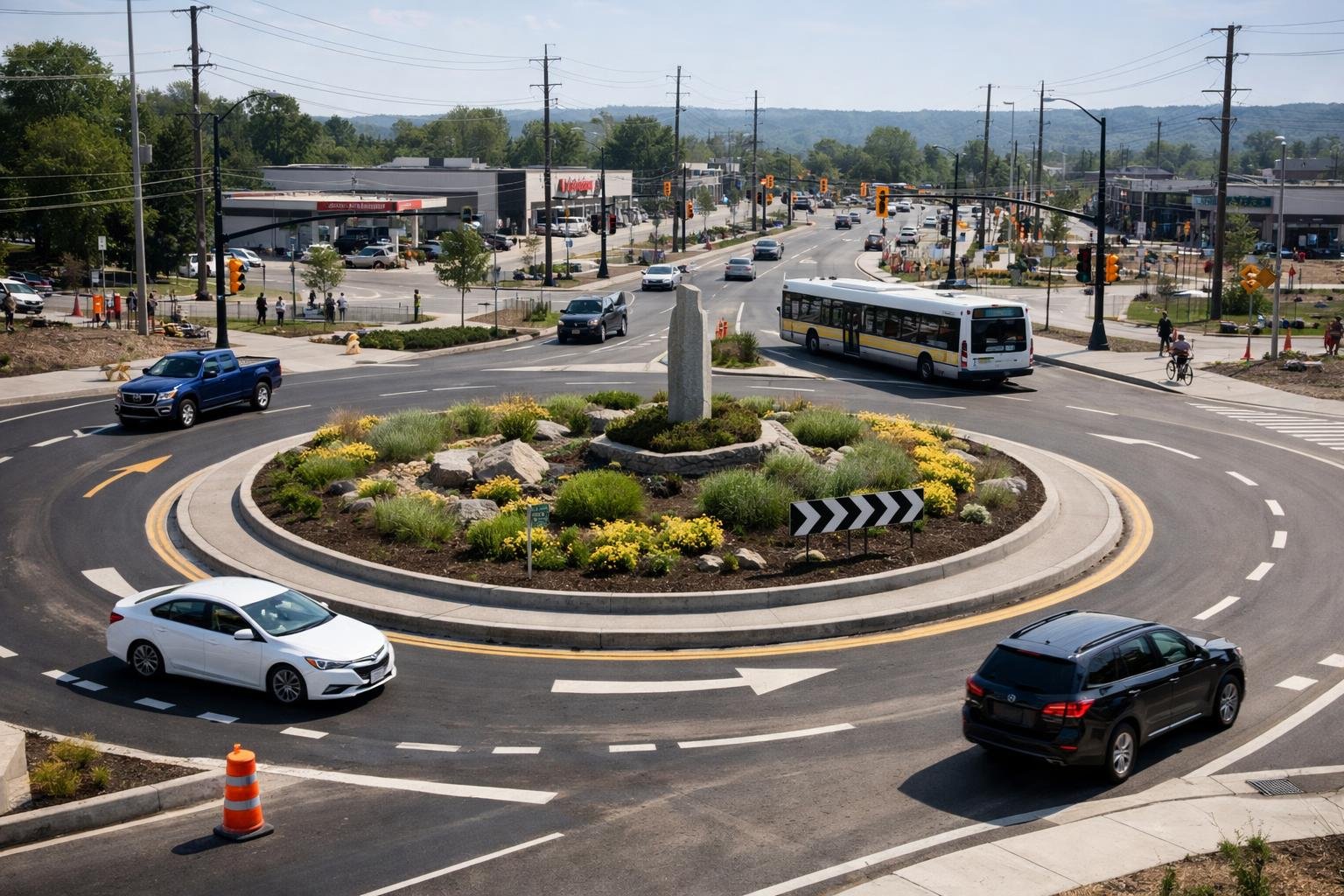
After two years of cones, detours, and night work under floodlights, Hamilton finally flipped the switch—or rather, removed it. The city unveiled a modern, multilane roundabout Friday at the meeting point of Main Street East, King Street, and Gage Avenue North, a junction that has long been the city’s busiest and most crash‑prone. Crews swept up the last gravel, landscapers tucked in the final perennials, and traffic flowed in a steady, almost surprising hush.
“It’s a big change, but a smart one,” said City Engineer Priya Desai, watching the morning peak settle into its new rhythm. “We’ve traded red lights for continuous movement. That means less idling, fewer severe collisions, and a better experience for people on foot and on bikes.”
Why the city made the switch
For years, the sprawling signalized crossroads strained under 55,000 vehicles a day, with queues snaking back multiple blocks. Injury crashes—especially high‑speed T‑bones—were a persistent worry. International studies show that converting from signals to roundabouts can reduce injury collisions by up to 75%, largely because conflict points drop dramatically and speeds remain low and consistent.
“This design is about safety first, efficiency second,” Desai added. “Instead of stopping and starting, drivers yield, merge, and circulate at predictable speeds.”
What’s different on the ground
The new layout is a two‑lane roundabout with a landscaped center island and truck aprons to help long vehicles navigate turns. Crosswalks are set back with raised entries, and medians create safe refuge islands so pedestrians cross one direction at a time. Cyclists get protected approaches and optional ramps to join the shared‑use path around the perimeter. Overhead signs, spiral lane markings, and high‑contrast arrows guide drivers into the correct lane before they enter.
Transit didn’t get left out: curbside bus bays reduce dwell time, and tactile paving at the crossings improves wayfinding for riders with low vision.
Early reactions from the street
Not everyone was instantly comfortable—first weeks at any roundabout bring nerves. But by mid‑morning, patterns emerged.
“I’m seeing steadier headways already,” said Jerome Banks, a Hamilton Street Railway driver. “The buses keep rolling. The smooth arc helps our schedule.”
A café owner on the corner, Lila Mendoza, said, “The last two summers were rough with construction fences. But today? Windows open, less honking, and we’ve had new faces all morning.”
Longtime resident Nadia Wasilewska offered a cautious thumbs‑up: “I was skeptical. Now, if drivers just remember to yield and signal, I think it’ll work.”
By the numbers
City staff set up portable sensors and video analytics to compare performance. Early readings—backed by modeling—suggest meaningful gains.
| Metric | Before (Signalized) | After (Roundabout) |
|---|---|---|
| Average delay per vehicle (peak) | 80–95 seconds | 18–30 seconds |
| Peak-hour throughput | ~5,200 vehicles/hr | ~6,000 vehicles/hr |
| Annual collisions (five‑year avg.) | 28 | 12–15 (projected) |
| Pedestrian crossing time (typical cycle) | 90–120 seconds | 30–50 seconds |
| CO2 from idling (per weekday) | ~42 tons | ~33 tons |
| Noise complaints (monthly avg.) | 19 | 7 (projected) |
“These are preliminary, but they track with the engineering models and with what we’ve seen in comparable Canadian cities,” Desai said. “The key is steady speeds around 30–35 km/h and fewer hard stops.”
How the build took two years
Why so long? Utilities. Beneath the pavement, crews relocated an aging water main, bundled telecom ducts, and upgraded storm drains to handle cloudbursts. Supply‑chain delays and night‑work limits extended the schedule, but the city used the time to add separated cycling facilities, new LED lighting, and pollinator‑friendly plantings in the center island. The total project budget was approximately $29 million, supported by provincial and federal funds aimed at road safety and emissions reduction.
Learning curve and enforcement
A two‑week “soft launch” precedes any strict enforcement. Police and trained ambassadors are stationed at each approach, offering flyers and quick coaching.
Key reminders printed on signs and pavement:
- Choose your lane before you enter; follow the painted arrows and overhead signs. Yield to circulating traffic and to pedestrians at the crosswalks. Keep moving inside the circle—don’t stop in the lane. Signal your exit. Give large trucks extra room; they may straddle lanes.
“We’d rather teach than ticket,” said Sgt. Alisha Moore of Hamilton Police. “Most errors are about lane choice and signaling. A little practice fixes that.”
Accessibility and design details that matter
The city emphasized universal design. Raised crosswalks create a gentle speed hump at entries, detectable by cane or chair casters. Tactile warning strips line each crossing. Audible beacons, activated by pushbuttons, help people time crossings during lulls. For people biking, mountable curbs provide forgiving edges, while green thermoplastic highlights conflict zones.
At the heart of the island, native grasses and a modest public art piece nod to the area’s industrial roots. The greenery is more than ornamental—it enhances sightlines by keeping the center low while screening oncoming headlights at night.
What comes next
Transportation staff will monitor performance for 12 months, tweaking lane markings or signage if patterns warrant. Two nearby corridors—Cannon Street and Barton Street—are being studied for mini‑roundabouts at selected intersections, and a winter safety audit is already on the calendar.
“It’s not just a new circle of asphalt,” Desai said. “It’s a template for how Hamilton can move people safer, quicker, and with a little more calm.” As drivers settle into the rhythm—yield, merge, exit—the city hopes the roundabout’s quiet efficiency will speak for itself.
