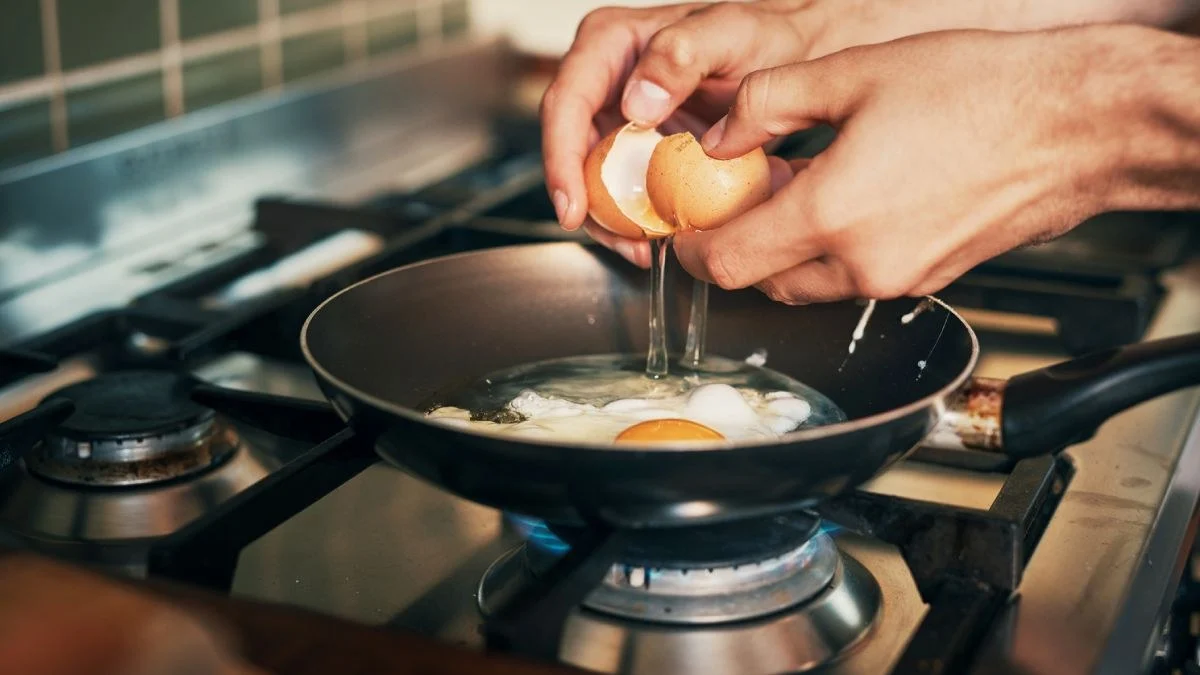
Rather than a drizzle of oil or a knob of butter, a pinch of flour. This is the trick Marmiton highlighted again on September 23 to prevent the fried egg from sticking to the pan.
It is not new: late in 2024, the site 750g had already relayed it, attributing it to Laura, from the Instagram account “Jimmy and Laura Tips.” The principle is summed up in one sentence: slip a very thin layer of flour between the egg and the bottom of the pan. The whole secret lies in the word “very.”
A veil of flour, not a coating
The method described by Marmiton is carried out in four steps. Start with a clean, dry, and cold pan, preferably nonstick. Dust a pinch of flour on the bottom. Then remove almost all of it with a sheet of paper towel. In the end, only a barely visible veil should remain.
If the bottom of the pan is still clearly white, there is too much flour. As it heats, this surplus can brown, impart an unpleasant taste, and leave marks beneath the white surface.
Next, heat over low or medium heat, crack the egg, and above all, leave it alone. When the white has turned opaque and its edges lift easily, a thin spatula is enough to lift it away. A flame that is too high is the mistake to avoid: the flour may burn before the white sets.
Why the egg sticks to metal
Egg white is rich in proteins. As it heats, these proteins can form bonds with the metal atoms of the pan, such as iron. This is explained by the Royal Society of Chemistry, the British scientific society of chemists, in its educational resources. All the countermeasures against the sticking effect thus rely on the same idea: limit direct contact between the food and the metal.
The fat (oil or butter) fills this role by forming a film between the two. The nonstick coating does as well. With the flour trick, it is this fine veil of powder that is supposed to serve as an intermediary. The explanation is coherent, but no serious comparative tests of this method have been found. The claimed results rely on cooking experiments and testimonials.
Cold pan or hot pan: the versions diverge
Another point to know before trying: not all versions of the trick look the same. Marmiton recommends flouring the pan while cold, then heating gently. The version relayed by 750g does the opposite: we heat the pan first over medium heat, sprinkle the flour, wait a few seconds, then crack the egg. Some sites even advise adding a little oil or butter anyway, which undermines the main appeal of the trick.
Starting cold reduces the risk of burning the flour, since it heats gradually with the pan. In any case, the rule remains the same: a minuscule amount and moderate heat.
What flour does not replace: a good pan
We also need to scale back expectations about what flour actually brings. A well-maintained nonstick pan can already cook an egg without fat. The American consumer association Consumer Reports has made it a testing protocol. After an initial greasing of the new pan, they cook four eggs in a row without oil to check if they release on their own. The best models release them without any help.
The culinary media The Kitchn has also tried cracking an egg into a cold, empty nonstick pan, with no fat. The cooking was gentle, without golden edges, but it took about six minutes. And the egg was judged noticeably less tasty than those cooked in oil or butter.
Put differently, on a new coating, flour mainly serves a safety role. On stainless steel or ungreased cast iron, it does not guarantee a perfect result, acknowledges Marmiton. The same goes for a scratched or worn coating: if the eggs stick every time, the utensil is to blame, not the technique.
If you are mainly looking to cut fat, another method circulates: cooking the top of the egg by steam with a splash of water and a lid. It aims especially to avoid flipping the egg. The flour, on the other hand, tackles the bottom.
One last practical detail: plain wheat flour contains gluten. For a guest who is gluten-intolerant or celiac, it is better to return to oil, or rely solely on a good nonstick pan.
