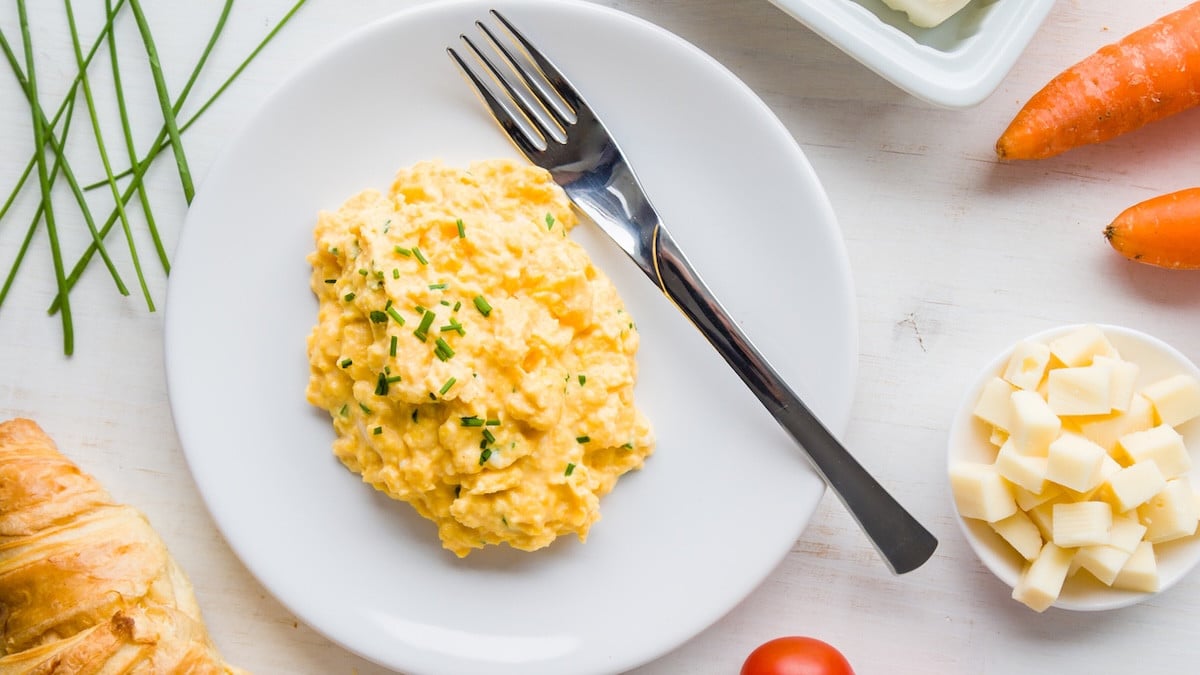
Although the making of this classic of gastronomy seems within reach of everyone, achieving a perfect texture is a real culinary challenge. No more results that are too dry or rubbery: Chef Cyril Lignac reveals his infallible secret to master the coagulation of proteins and to perfect scrambled eggs with a creaminess worthy of a fine restaurant. A technique of slow cooking using an emulsion of liquid cream that will change your brunch rituals forever. We reveal his step-by-step method.
Cyril Lignac’s 4 Golden Rules:
- Starting cold: Always pour your eggs into a cold pan to control the temperature.
- Low, steady heat: Stir continuously for 5 minutes using a spatula.
- Final binding: Fold in the liquid cream at the end of cooking to stop the heat.
- Toppings at the end: Add your ingredients (cheese, ham…) only at serving time to preserve the softness.
The mistake everyone makes with scrambled eggs
Most of us make the same mistake right from the start: we heat our pan and pour the beaten eggs into it. This is precisely what Cyril Lignac advises against! Cooking eggs in a hot pan means exposing them to too rapid cooking, lumps and a final texture that is too firm and dry, far from the creaminess we expect from scrambled eggs. So the chef’s secret lies in three words: start cold.
Cyril Lignac’s step-by-step technique for perfect scrambled eggs
Always start cold
You must absolutely pour the beaten eggs into the saucepan or skillet BEFORE lighting the flame. This fundamental rule allows you to control the temperature and avoid overly abrupt coagulation of the proteins. It’s the baseline for successful cooking.
Low heat and continuous stirring
The cooking of scrambled eggs must be gentle, long, and delicate: count about 5 good minutes. No, scrambled eggs are not fast! And during all this time, you must stir constantly with a wooden spatula or a silicone spatula, making slow circles at the bottom of the pan. You must NEVER let the eggs cook without movement, lest patches of coagulated protein form.
Another tip to remember: remove the pan from the heat from time to time during cooking. This simple gesture slows the temperature rise and helps keep control over the final texture.
Liquid cream: the ingredient that changes everything
This is the pivotal moment that many people overlook. When the eggs begin to thicken but are still quite soft (after the famous 5 minutes), add the liquid cream and mix immediately to stop the cooking and obtain an even more velvety texture.
If you want to go even further in crafting chef-worthy scrambled eggs, you can whip the liquid cream into a savory Chantilly, then fold in a large spoonful of it at serving time for more lightness and unmatched creaminess.
Seasoning at the end, not at the start
Contrary to what you might think, you do not salt the eggs before cooking. Salt and pepper are added during cooking with small knobs of butter. If you salt too early, it could denature the proteins and make the eggs too watery. So forget your salt shaker and your pepper at the start of the recipe!
Garnishes: before or after?
If you want to add indulgent and generous garnishes to your scrambled eggs (ham, cheese, vegetables, bacon…), it is ALWAYS after, once the eggs are ready! Adding these ingredients too early could disrupt the cooking and alter the soft texture we seek with scrambled eggs.
Our ideas for garnishes that work every time? Finely chopped chives, smoked salmon, grated parmesan, or mushrooms grilled with garlic and parsley. A true delight!
Summary of Lignac’s method for scrambled eggs worthy of a fine restaurant
For scrambled eggs that are perfectly successful, you simply need to remember these four simple rules: start cold, cook on low heat while stirring continuously, add the cream at the right moment to stop the cooking, and incorporate garnishes only at the very end. In less than 10 minutes, you will obtain silky, creamy eggs that have nothing to envy from those of great chefs!
Now it’s up to you to impress your palate and that of your guests at your next brunch.
