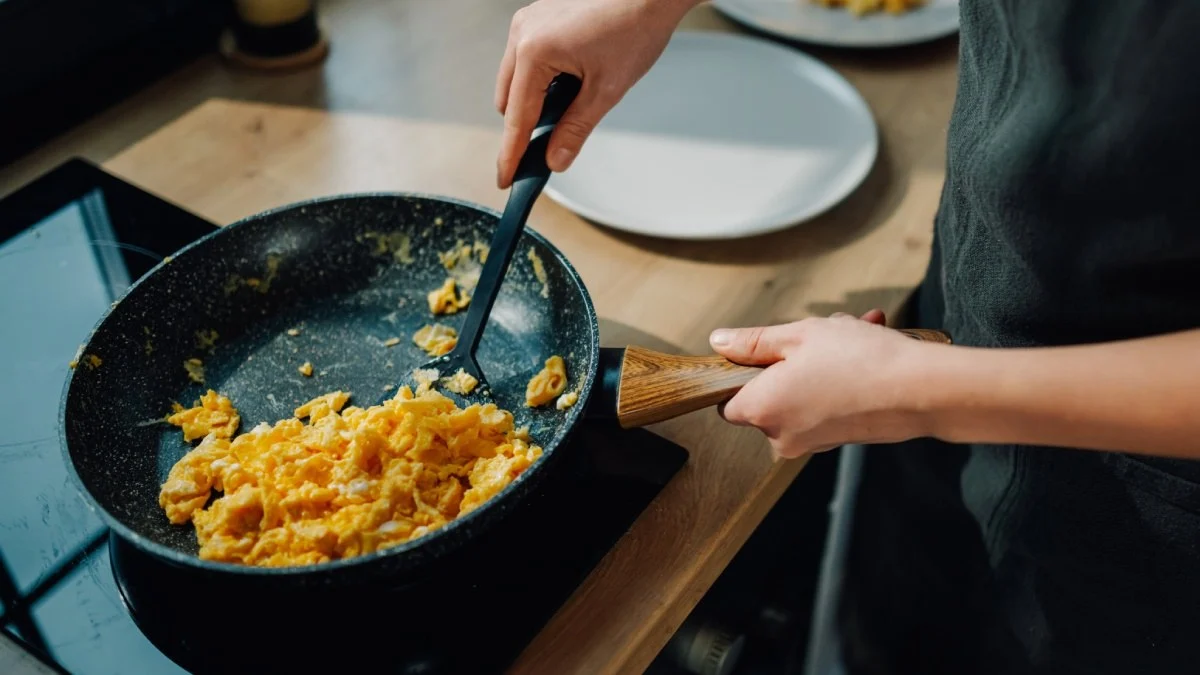
There are few morning disappointments comparable to a plate of dry, rubbery scrambled eggs. It’s one of the simplest dishes in the world, three minutes of cooking, and yet one of the easiest to miss. And the culprit often hides well before the pan, at the moment you crack the eggs into the bowl.
The gesture is almost automatic in millions of kitchens: a splash of milk, sometimes a dash of cream, meant to make the eggs creamier. Except that two of the most respected chefs of their generation, Anthony Bourdain and Jacques Pépin, never used any. Not a drop.
Anthony Bourdain: no milk, no cream, no water
In 2016, in a filmed interview for Insider Tech, Anthony Bourdain detailed his method. It boils down to four ingredients: eggs, salt, pepper, and plenty of butter. Nothing else.
“I don’t add water, I don’t add cream. I simply don’t feel that milk or cream brings anything to the dish.”
His logic was clear, and very French in spirit: the dish should speak of the egg, not of what surrounds it. “I’m old school,” he explained. “I think scrambled eggs, or an omelet, are above all an egg story.” Before adding the rule that has circulated the kitchens: You don’t make a quiche.
The excess liquid, in his view, dilutes the flavor. And since there’s nothing to hide behind in such a stripped-down preparation, he emphasized one point: use fresh, good eggs. That’s the only luxury that matters here.
His technique, in four steps
Bourdain also had a very precise method, which he detailed in this video and which explains a good portion of the result.
First, a hot pan. “Not scorching hot, but hot.” Then he cracks his eggs into a small cup rather than directly into the pan, in order to spot any shell fragments. He beats them with a fork, without overdoing it: he still wants to see marbling of white and yolk. If the mixture is a uniform yellow, it’s already overmixed.
The eggs go immediately into the pan where the butter is foaming. He lets them set for a few seconds, then moves them in an eight-shaped pattern with his spatula. The result he aimed for: eggs that are “gooey,” still glossy, never dry.
Jacques Pépin says exactly the same thing
The French chef, trained in France before becoming an institution in the United States, applies the same rule. In the American Masters at Home video shot for PBS, he cracks his eggs, adds salt, pepper, and a bit of chives to the bowl, then beats vigorously. No milk at this stage.
The cooking takes place in a saucepan rather than a skillet, over medium heat, with a whisk that he never lets go. The goal: as few small curds as possible, a creamy texture close to custard.
And that’s where his trick arrives. He sets aside two or three tablespoons of raw eggs before cooking, and reincorporates them off the heat at the last moment, with a little cream. This cold dose stops the cooking dead in its tracks and prevents the eggs from continuing to firm up in the pan. In other words: the cream goes in at the end, not at the beginning. It’s not at all the same thing.
So, should we really ban milk?
That’s where the debate gets interesting, because culinary science does not entirely side with the purists. America’s Test Kitchen, the outfit behind Cook’s Illustrated and renowned for testing every recipe dozens of times, has debunked the mechanism.
When eggs heat up, their proteins unfold and bind to form a network that traps water. The hotter it gets, the tighter this network becomes, until it becomes elastic and rejects its water. This is precisely the definition of rubbery scrambled eggs.
A little liquid dilutes these proteins and prevents them from bonding too tightly. It also helps the curds swell during cooking. The problem isn’t the milk itself, it’s the quantity. Testers recommend one to two teaspoons of liquid per egg, not more. Whole milk, semi-skimmed, cream, plant-based drink, or even simply water: all work, only the mouthfeel changes.
Yet in real life, almost no one measures. People pour by eyeballing, often the equivalent of three or four times that dose, and you get the opposite effect of what you were aiming for: eggs that cook too soft, releasing their water on the plate and with a flavor that’s evaporated. Bourdain was wrong about the chemistry, but right about the result.
Three details that change everything
Salt first, not after. It’s counterintuitive, but salt incorporated into raw eggs limits interactions between proteins and softens the network. It also seasons evenly. And if you let it rest a few minutes, the salt relaxes the whites, helping them blend more easily with the yolks.
Use a small pan. The smaller the surface, the less the eggs spread, and the slower the cooking. You gain a few seconds of control, which is more than enough to make the difference between creamy and overcooked. A 20 cm pan is enough for up to six eggs.
Turn off the heat too early. The eggs continue to cook in the hot pan after you switch off the heat. If you wait until they look perfect, they will already be overcooked by the time you serve. Remove them while they still look a touch too runny.
The rule to remember
You don’t have to choose a side. If you like the straightforward and concentrated character of the egg, do like Bourdain: eggs, salt, pepper, butter, and nothing else. If you insist on your splash of milk, keep it, but measure it carefully. One teaspoon per egg, measured, not poured by instinct.
In both cases, the real lever remains elsewhere: the temperature. No addition will save eggs cooked too hot. Medium heat, a spatula that never stops, and an plate ready beside the pan.
