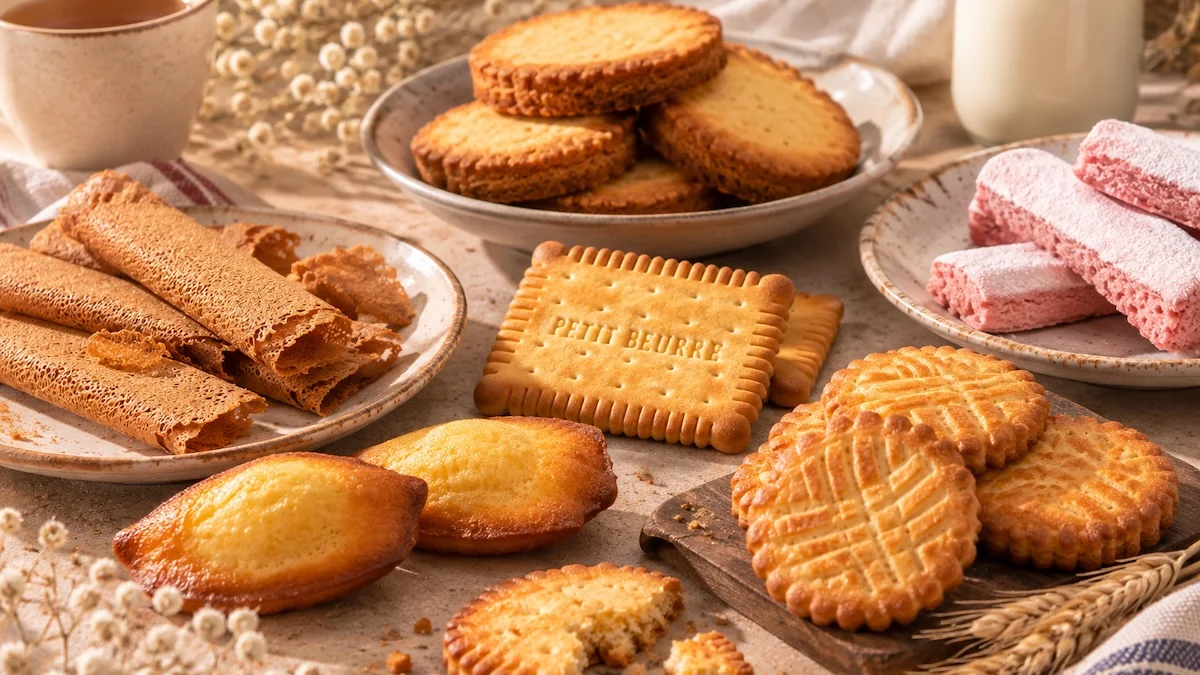
Biscuits and cakes are so much a part of our daily lives that we almost forget everything that happens before they arrive on our shelves. Yet behind a simple biscuit or cake lie raw materials carefully selected, machines, men and women, checks at every step to guarantee impeccable quality and above all, real know-how. To understand what is at stake behind biscuit making, we followed the various production steps of the Véritable Petit Beurre LU, directly at the heart of its factory in La Haye-Fouassière.
From Field to Package: What Happens Before You Bite Into a Biscuit or Cake?
Before becoming the familiar little biscuit that we all know, the Véritable Petit Beurre (or VPB for the intimate) starts far from the production line. Because making a biscuit begins with working with raw materials whose selection and traceability play a crucial role.
Flour, butter, sugar, eggs… These ingredients are at the heart of many recipes for French biscuits and cakes. The sector pays particular attention to their selection: according to the Syndicat des Biscuits, Gâteaux et Panifications de France, the supply of butter, sugar, flour and eggs is essentially French, and when possible, sourced close to the production sites. A proximity that notably facilitates ingredient traceability and guarantees consumers the quality of the products.
For the Véritable Petit Beurre LU, this story begins with wheat. The biscuit is produced in La Haye-Fouassière, near Nantes, from wheat harvested by local farmers. In other words, before the factory doors even open, an entire supply chain is mobilized behind every pack of biscuits or cakes.
How Is a Petit Beurre Actually Made?
Before discussing its entire manufacturing process, we take a moment to remind you of its history. A history that goes back more than 130 years!
If the Véritable Petit Beurre LU is today recognizable at first glance, it is not by accident. In 1886, Louis Lefèvre-Utile, cofounder of the brand, imagined this biscuit by drawing inspiration from napkins. Even the details of its shape carry a precise symbolism!
The four corners represent the four seasons, the 52 teeth correspond to the 52 weeks of the year, the 24 perforations echo the 24 hours of the day, while its exact size of 7 cm refers to the seven days of the week.
A rather original way to transform a simple biscuit into a true everyday object and to give it a unique identity. And it is very close to its birthplace, in La Haye-Fouassière, that the Véritable Petit Beurre continues its great adventure.
Once the raw materials arrive at the site, they are gradually transformed to give birth to the biscuit. It is a sequence of precise steps where every operation counts to obtain a product that is regular and compliant with quality requirements.
From Raw Material to Dough
The first step is to work the different ingredients in massive mixers to obtain the base of the biscuits. And behind each recipe of the roughly 80 families of biscuits and cakes in France, which may seem very simple, lies a high mastery of proportions, temperatures and the different manufacturing parameters specific to each of them. The common objective? To have a dough sufficiently homogeneous to be shaped and baked in a regular way.
Shaping to Baking
Once ready, the dough enters a new phase of transformation: it is shaped to take the characteristic form of each biscuit before passing through the baking stage. It is at this moment that the biscuit gradually takes on its appearance, its color and its texture.
By the way, if you want to shine in company the next time you share a VPB, did you know that each biscuit passed through an oven nearly 100 meters long before being fully baked? And that around 5,500 biscuits were baked every minute?
Although the Véritable Petit Beurre recipe is old, its production today relies on industrial processes that accurately reproduce the characteristics of the biscuit, while ensuring large-scale production.
Checks at Every Step
In a factory, producing a lot of biscuits does not mean reducing quality. On the contrary!
Quality is closely monitored throughout the process. The quality approach begins with the selection of raw materials and continues during their transformation. The supply chain is strict about these regulations, and many manufacturers have also chosen to reinforce their quality approach by committing to a certification process. The aim is to ensure that the product leaving the line meets the defined requirements.
Last Step: Off to the Packaging
Once shaped, baked and checked, the biscuits continue on to the packaging line. This is the final step before they depart the factory and arrive on the shelves. The package we grab in the store is therefore the culmination of a journey much longer than it seems.
For the Véritable Petit Beurre, it is a journey of almost 400 meters from the mixer to packaging!
Behind Every Industrial Biscuit and Cake, It Is Mostly Men and Women Who Work Every Day
When you think of a factory, you easily picture machines running continuously. And while that is not entirely wrong, behind these production lines there are people who oversee the smooth running of operations.
The biscuit and cake supply chain relies on skills that are passed on, perfected, and that evolve with new technologies. The French sector thus claims a true know-how, inherited from several generations of bakers, pastry chefs and biscuit makers.
This human dimension is closely linked to the territorial roots of the sector. Biscuit, cake and bakery product companies contribute to maintaining thousands of direct and indirect jobs across the country!
Behind every biscuit and cake we eat in a few bites, there lies a whole chain of trades and skills that begins with raw material producers and continues through manufacturing workshops and ends with transport.
A Biscuit History That Goes Back Over 200 Years
In France, biscuits and cakes are an integral part of the country’s food, cultural and historical heritage. The sector claims more than 200 years of traditions and know-how, with recipes and specialties deeply linked to the territories.
From the pink biscuit of Reims to lace crepes, through spéculoos, crispy wafers, or regional specialties, the French biscuit heritage is richer than you might imagine. And this history continues to be handed down. Some companies remain run by founding families many generations after their creation, while others have been taken over by enthusiasts who chose to preserve their recipes and know-how.
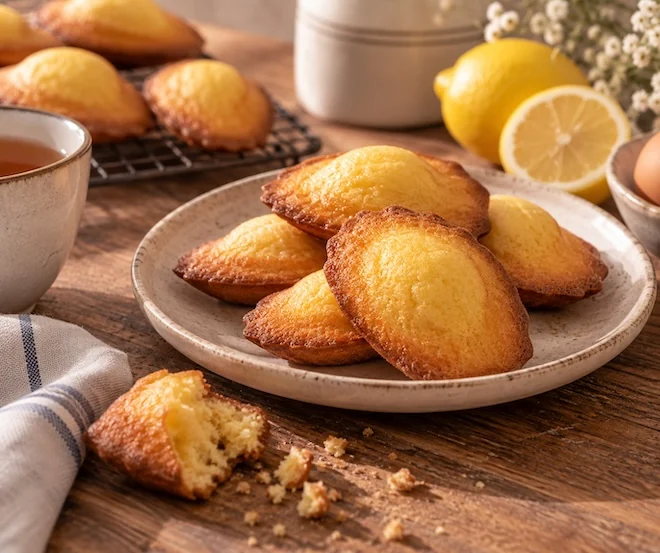
This commitment to preserving traditional recipes also involves precise rules: for certain biscuits and cakes (such as boudoirs, madeleines or pound cakes among others), the trade has adopted codes of practice defining the characteristics to respect in order to be able to use these names. Not every treat qualifies as boudoir!
The French biscuit industry thus evolves, but it never starts from scratch again.
Making Today’s Biscuits Also Means Thinking About Tomorrow
Preserving recipes and know-how isn’t enough anymore. Like many sectors of the agri-food industry, biscuit-making must today respond to new expectations: origin of ingredients, nutritional quality, environment, packaging, and waste reduction.
More Sustainable Raw Materials in the Fields
Wheat, flour, butter, eggs. The origin and production methods of these raw materials can play a role in manufacturers’ environmental approach. Several players in French biscuit-making are developing initiatives to promote more responsible sourcing and encourage farming practices more respectful of the environment.
Some companies notably favor French agricultural supply chains, partnerships with farmers, or approaches aimed at preserving soils and biodiversity, such as the CRC Culture Raisonnée Contrôlée system, which brings together wheat producers committed to practices designed to preserve natural habitats and pollinating insects. Other programs focus on reducing pesticide use or developing more sustainable farming practices.
These initiatives illustrate a willingness to evolve sourcing and production methods while maintaining the quality of the raw materials essential to making our favorite biscuits and cakes.
Packaging Is Also Evolving
Packaging also plays a special role in the sector: biscuits and cakes are fragile and must be protected to guarantee their preservation and transport to your cupboards.
Manufacturers are therefore seeking a balance between product protection and reducing environmental impact. Several initiatives have been implemented in recent years, starting with reducing the size and weight of certain packaging, eliminating over-packaging, developing recyclable cartons or pouches, or using recycled materials or materials sourced from sustainably managed forests.
Raising the Recipes Without Losing the Pleasure
The other current challenge is, of course, nutrition.
For several years, the French biscuit and cake sector has mobilized to adjust certain recipes to meet nutritional challenges and rising consumer expectations regarding composition, such as reducing sugar, salt and saturated fats, but also increasing fiber.
For example, between 2020 and 2025, in the biscuit and cake segment, there is a trend of nearly a 10% increase in average fiber content (according to Ciqual table estimates).
Between 2011 and 2018, the latest OQALI report highlighted a 5% reduction in average salt and saturated fat content for this sector.
And this issue is significant because it means evolving products without taking away what makes them successful: their taste, their texture, their indulgence.
From Tradition to Innovation: French Biscuit Making Reinvents Itself
So, ultimately, what lies behind a biscuit?
Much more than a simple succession of ingredients and transformation steps. From the selection of raw materials to the packaging, the entire process relies on checks, skills, and know-how that allow precise reproduction of a product.
The Véritable Petit Beurre is a good concrete example. Its appearance and its history are intimately linked to a tradition born in the 19th century, but its production today takes place within a modern industry, attentive to quality, traceability, and new environmental and nutritional challenges. And it’s the same for almost all French biscuits and cakes!
More broadly, the sector seeks to harmonize two dimensions: preserving a biscuit heritage over 200 years old while continuing to innovate.
And ultimately, perhaps that’s what we forget when we open a pack of biscuits or cakes. Behind every bite lies an entire supply chain. Farmers who cultivate raw materials, teams who master manufacturing processes, quality controls, companies rooted in their regions, and the know-how passed down for generations.
So yes, we eat biscuits and cakes all year round. But now, we will know everything that lies behind them.
