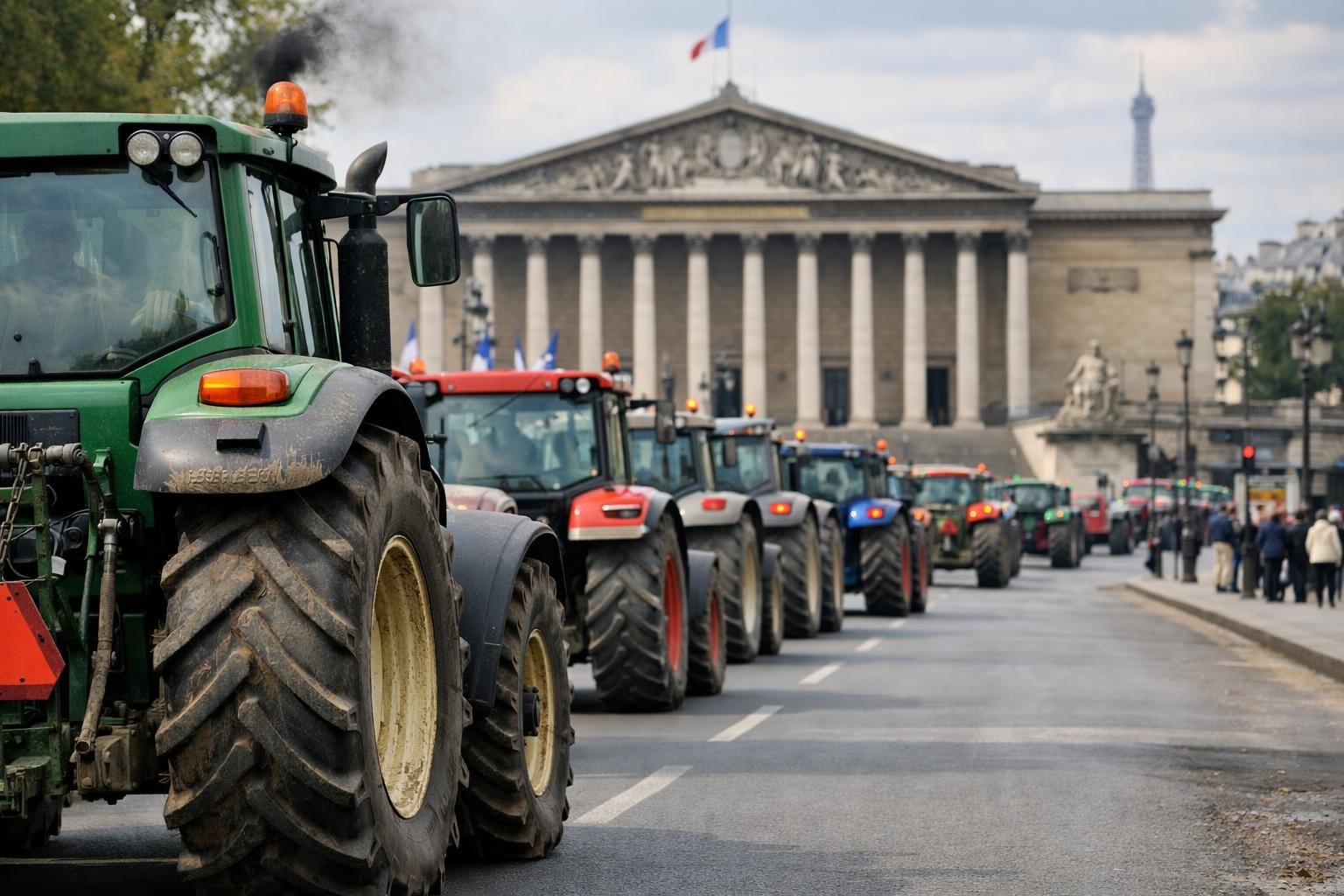
Dawn breaks cold and pink over wet tarmac. Headlights gather into a slow-rolling constellation, the rumble of diesel bouncing off hedgerows. On each cab, hand-painted boards: Keep food local; Let us farm. Passing villages wave, film, or simply stare as the convoy edges toward the capital, where lawmakers will be waiting—alongside a grid of cameras and a growing to-do list.
The mood in the cabs is not theatrical. It is practical, jittery, and, above all, tired. Margins feel fragile, patience thinner still. “We can live with change,” says one grower over the CB, “but we can’t live with chaos.”
What sparked the convoy
Officials unveiled a package of environmental and animal welfare measures this winter, tying compliance more tightly to payments and market access. Some provisions are hardly controversial: buffer strips along waterways, better slurry storage, traceability upgrades. Others, farmers say, land like a short-notice audit on a rainy Tuesday—technically doable, financially punishing.
What’s new is the pace. Paperwork deadlines bunched into spring. Inspections stacked just as planting windows narrowed. “The calendar broke before the tractors did,” a grain producer quips. Small mixed farms, with less admin capacity, feel it acutely. “If I’m on a laptop,” one livestock keeper says, “I’m not in the lambing shed.”
On the road: voices from the cab
“We’re not against rules,” insists Mara Patel, who rents 180 hectares and grows barley, beans, and cover crops. “We’re against bureaucracy that forgets the field is also an office, a workshop, a family.”
Alongside her, a young contractor taps the steering wheel. “I did the soil course, I pay for the lab tests, I planted hedges. Then the forms change mid-season. It’s like trying to hit a moving gate.”
Their demands are, in their telling, less about ideology than predictability:
- A realistic phase-in for new inspections and digital reporting, with a clear, single portal and helpline
The government’s stance
A ministry spokesperson frames the package as overdue modernization. “Our food system must be productive and resilient while meeting climate and nature goals. These measures reflect international standards and will help farms stay competitive in the long run.”
Officials say concessions are already on the table: grace periods, simplified guidance, and “earned recognition” so certified farms face fewer visits. “We are listening,” the spokesperson adds, pointing to roundtables scheduled this week. “But we cannot postpone environmental obligations indefinitely.”
What changes are actually on paper
Behind the slogans sits a tangle of clauses. Here’s how farmers and officials describe the most contested pivots.
| Issue | Previous framework | New draft rules | Farmers’ ask |
|---|---|---|---|
| Pesticide reporting | Annual summary by parcel | Real-time e-logs within 48 hours | Monthly batch uploads; offline allowance |
| Buffer zones near water | 3–5 meters typical | 10 meters for sensitive catchments | Targeted zones based on risk maps |
| Manure/slurry storage | 4 months capacity | 6 months, covered | 6 months with phased grants first |
| Animal welfare audits | By appointment, annual | Unannounced spot checks | Hybrid: notice unless risk flagged |
| Hedgerow management | Closed period, guidance-led | Mandatory cut windows + mapping | Same windows, but fewer mapping steps |
| Payment link | Partial cross-compliance | Full compliance to access schemes | Tiered deductions, not full lockout |
Policymakers argue that better data enables targeted support and that clarity on standards helps lenders back on-farm investments. Farmers counter that clarity late in the season is not clarity at all—and that cash-flow pain arrives long before any promised market premium.
The wider stakes
Consumers might not feel this today, but a slow grind has begun. Price is only part of it. Storage upgrades tie up capital. Extra field margins mean fewer saleable rows. A wet spring can wipe out both plans and patience. “Agriculture carries systemic risk for the rest of us,” says Anya Robins, an agricultural economist. “Kill livelihoods, you risk killing optionality—on domestic supply, on landscape management, on rural employment.”
Environmental groups see a different risk: backsliding. “Rivers are choking; soils are exhausted,” says Theo Nguyen of the water-shed coalition. “Strong rules level the playing field so good actors aren’t undercut. Delay just means paying more later.”
And yet, he concedes, delivery matters. “If the app freezes in a barn with no signal, that’s not resilience, that’s magical thinking.”
How the day may unfold
Police liaison teams expect a go-slow but cooperative procession into the city, with rolling closures and diversions. Organizers have briefed drivers: no blocking emergency routes, no idling near hospitals. The theater is deliberate but bounded—a show of force that still gets everyone home for evening checks.
Inside the building, committee chairs have carved out extra time. MPs will sift amendments: a six-month phase-in for e-logs; calibration support for sprayers; a rural connectivity clause tying compliance to actual broadband speeds. An amendment on earned-recognition audits has quiet cross-party traction.
What comes next likely won’t be tidy. A handful of changes may pass quickly; others will be pushed into pilot zones, turning the whole country into a quilt of tests. That frustrates some and reassures others. Pilots can be proof or pretext.
Along the embankment, the convoy finally bunches, exhaust ghosting in the chill. Someone kills their engine and the silence is startling. Helmets and flat caps mingle. Placards look homemade because they are. “Give us rules we can keep,” says a dairy farmer softly, “and we’ll keep them. Give us moving targets, and we’ll miss—together.”
The day’s script now hinges on whether both sides can find compromise that lands in the field, not just in a file. If the talks yield breathing room and a cleaner map, the tractors will turn for home. If not, they will be back—slower, louder, harder to ignore.
