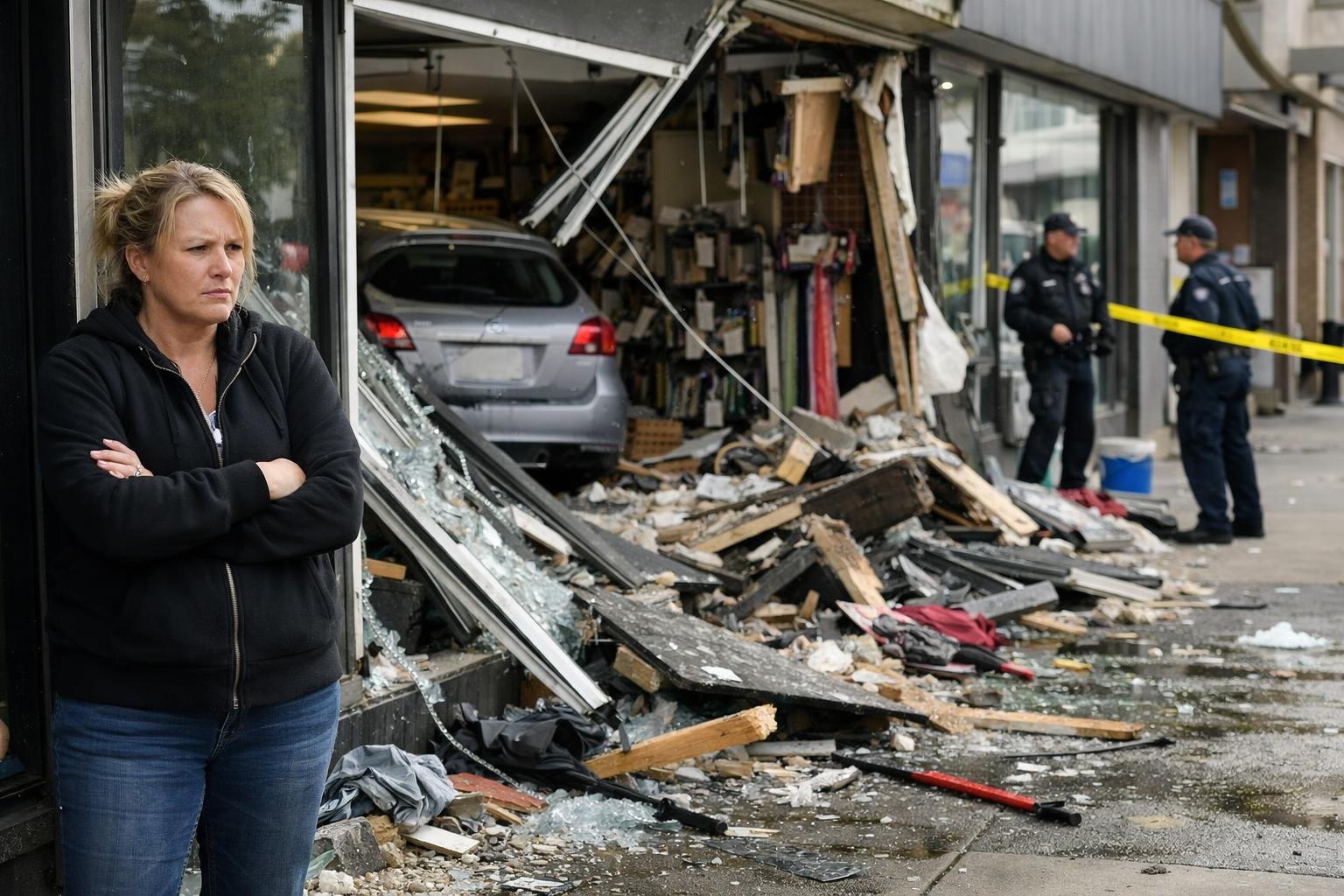
She heard the engine first—low, impatient, a growl cutting through the early-morning silence. Then came the scream of metal, the sickening crack of tempered glass, and a spray of light from headlights that should never have been inside a boutique.
"It happened so fast," says Mira, the owner of a small homewares shop on a busy Hamilton strip. "One second I was checking the online orders. The next, the front of my life’s work was just… gone."
The moment everything shattered
Just before dawn, a car reversed hard into the storefront, shearing the door off its hinges and dragging the display window inward like a curtain in a gale. Boxes flew. Crockery exploded. The cash drawer coughed up coins across the tiles.
"I remember the smell of coolant and dust," she says. "There was a squeal of tires, a shape in a hoodie, and then my shop was just a gap in the street."
Neighbors came running. Someone started filming. Another called police. In the footage, you can see a figure hop over a nest of broken shelving with the lightness of someone who’s done it before.
"I kept thinking, don’t cut yourself," Mira says, shaking her head. "At the same time, I knew I was watching months of margin disappear."
A blur of glass and headlights
The timeline felt elastic. Seconds stretched; minutes snapped.
- 4:22 a.m.: A sedan prowls past the awning twice.
- 4:25 a.m.: Reverse acceleration, direct impact.
- 4:26 a.m.: Two people enter, grab small electronics and boxed goods; a third stays in the car.
- 4:27 a.m.: They’re gone.
Sirens took a little longer. "It felt like years," says Sanjay, who runs the cafe next door. "But later I checked the cameras. Eight minutes. That’s all it took to rewrite the entire block."
Mira kept breathing, focused on the tiny things she could control. She unplugged frayed wires. She moved a toppled candle away from a puddle of petrol. She called her insurer with hands that wouldn’t sit still.
"I told them, ‘It’s me. Again.’ And that’s when I started to shake."
Counting the cost
There’s the obvious: smashed panes, splintered frames, ruined stock. Then there’s the invisible damage—customers who don’t come back because the place looks wounded, the staff member who texts to say she can’t face opening today, the creeping fear that this is how it goes now.
"It’s not just the bill," Mira says. "It’s the way it bends your week, your plans, your confidence."
Here’s how her situation changed in a day:
| Aspect | Before the attack | After the attack |
|---|---|---|
| Entry security | Single laminated pane, roller grille | Reinforced bollards, laminated + polycarbonate |
| Lighting/CCTV | Standard LEDs, 2 cameras | Motion floods, 6 cameras + cloud backup |
| Staff morale | Steady, upbeat | Jittery, shift-swaps, shorter hours |
| Insurance excess | Manageable | Higher after claim, tighter conditions |
| Response time | Patrols within 15 minutes (typical) | Similar, but now direct line to duty sergeant |
| Foot traffic | Solid morning trade | Patchy; curiosity first, hesitation after |
"Everyone tells you to harden your site," she says. "But every layer adds cost. And if they want in, they just bring more force."
Why these attacks persist
Ask five retailers and you’ll hear versions of the same story: a changing economy, a secondary market eager for quick, untraceable goods, and a generation testing limits. Cars are easy to steal; storefronts, by comparison, are soft targets.
Police patrols help. So do cameras, bollards, and community vigilance. But there’s a rhythm to this—offenders strike fast, leave faster, and count on the lag between impact and response.
Retailers in the district say they’re adapting by:
- Upgrading to anti-ram bollards and layered glazing while rearranging floor plans so high-value items sit far from entrances, reducing the “grab-and-go” appeal within the first 30 seconds.
"I hate the way the shop looks with bollards," Mira admits. "It’s like dressing a smile in a mouthguard. Necessary, maybe. But you feel it."
The morning after
By mid-morning, passersby pressed faces to the taped-off hole, peering at the jagged geometry of the damage. A florist brought buckets of stems to brighten the temporary plywood. Someone slid a handwritten note under the door: "We’re with you."
Inside, there was aftershock: a mosaic of shards, the faint, sugary smell of broken candles, a shoeprint on the counter. Mira’s team arrived with brooms and calm voices. Music went on low. They started sorting what could be saved from what had to be written off.
"It’s the little acts of repair," she says. "Sweeping with a friend. Rewrapping a single unbroken mug. Calling a supplier who says, ‘We’ll rush a shipment.’"
Rebuilding the threshold
The new facade will be sterner. The front layout, wider and emptier, will force movement away from the street. A fogging system is on order. Insurance is signing off in sections. The to-do list reads like a fortress blueprint.
And yet, on a stool near the temporary door, Mira has placed a single lamp and a pile of notebooks. The lamp is warm. The notebooks are stitched in bright thread. People step around the cones and come in anyway.
"That first sale after we swept up," she says, "I cried. Not because of the money. Because it meant we were still here."
She looks at the plywood, at the chalked hearts children have drawn on it, at the community that insists on believing in small places. Then she smiles—tired, certain.
"They wanted a hole," she says. "We’ll give them a doorway."
