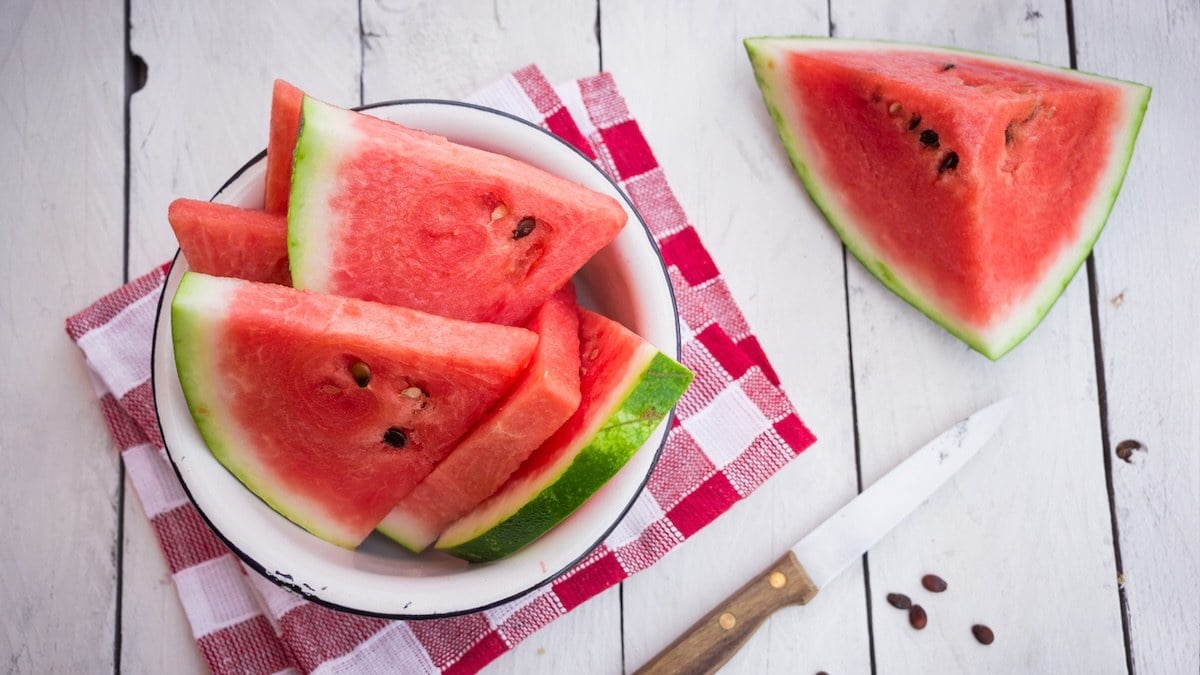
You cut a watermelon to enjoy its freshness all week long, but after 48 hours it becomes soft, its juice leaks in the fridge and its flavor fades? Rest assured, it is not a inevitability! With the right steps, this summer’s star fruit can stay firm, juicy and flavorful up to 7 days after being cut, i.e., three times longer than usual.
Why does cut watermelon deteriorate so quickly?
Watermelon is composed of more than 90% water, which makes it one of the most refreshing fruits of summer. But also, one of the most fragile once it is cut. As soon as its flesh is exposed to air, two phenomena occur at once: oxidation and moisture loss. The former causes color loss and alters the taste of the watermelon, while the latter makes the texture paste-like instead of crisp and juicy. The more the cut surface is in contact with air, the faster this process accelerates.
But there is also another detail that many of you do not know. Indeed, the watermelon continues to “breathe” after being cut, which means it will continue to release moisture into its container. Without any precautions on your part, this moisture stagnates around the pieces and promotes rapid softening, or even the appearance of mold in very little time (less than three or four days).
The method to keep a cut watermelon crunchy all week
To limit these two phenomena, the technique is to minimize the watermelon’s exposure to open air as much as possible, while removing excess moisture. Here’s how to proceed in five simple steps:
1. Small or large pieces?
Prefer cutting into large pieces rather than small dices. Indeed, cutting into large pieces will help your watermelon keep its juice inside rather than into small cubes that are more likely to dry out quickly.
2. Absorbent paper at the bottom of the box
To capture the moisture released by the fruit without letting it soak in its own juice, we recommend lining the bottom of an airtight box with absorbent paper before adding your watermelon pieces.
3. Do not stack the pieces
Try to use a box large enough to arrange the pieces without stacking them. If your box is small, consider interleaving a new sheet of absorbent paper between each layer of watermelon pieces.
4. Close and refrigerate
Your box must be completely airtight to keep your cut watermelon for a week! And remember to place it in the refrigerator, in the vegetable drawer rather than in the rest of the fridge where the air is drier and harsher.
5. Replace the absorbent paper regularly
Every 2 to 3 days, check the state of your absorbent paper and replace it if it’s saturated with moisture. It should stay “dry” as long as possible.
With this five-point method, the watermelon will keep its crunchy texture and sweet, delicious taste for 5 to 7 days (compared to 2 to 3 days in a simple unprotected box).
And for a half-watermelon not cut into pieces?
If you have only cut into the fruit but not fully, the principle remains the same but the action will obviously change (who has a box large enough to hold a half-watermelon?!). Cover the cut part with tight plastic wrap, making sure it sticks directly to the flesh to limit contact with air. Some first lay a sheet of absorbent paper on the flesh to absorb excess juice before sticking their plastic wrap. That will help it hold well!
Stored this way in the refrigerator, your half-watermelon will easily keep for 4 to 5 days without losing firmness.
The mistake you must not make
Are you also leaving your cut watermelon at room temperature to keep its flavor? Big mistake! More than two hours out of the fridge and the heat accelerates bacterial proliferation on a fruit already rich in water and sugar, the perfect ground for microorganisms. Even in the height of summer, cut watermelon must imperatively be stored in the fridge after cutting!
How to tell if it’s still good?
You’ve applied all the steps to properly preserve your watermelon and yet you have a slight doubt before taking a bite? There are a few signs to check its freshness. A watermelon that is still good keeps a firm flesh, a bright color and a very characteristic sweet aroma. If the texture becomes slimy, if a sour odor arises or if dark spots appear on the surface, no doubt: dispose of it without delay! When there is doubt, there is no doubt (and it’s better to throw it away than risk digestive trouble if you know what we mean…).
The last reflex to adopt, and this starts at purchase, is to choose a watermelon that is quite heavy for its size, with a fairly matte skin and a cream-yellow spot clearly visible where it rested on the ground. These are signs of ideal ripeness! And a well-chosen watermelon from the start makes preservation easier once it is cut.
