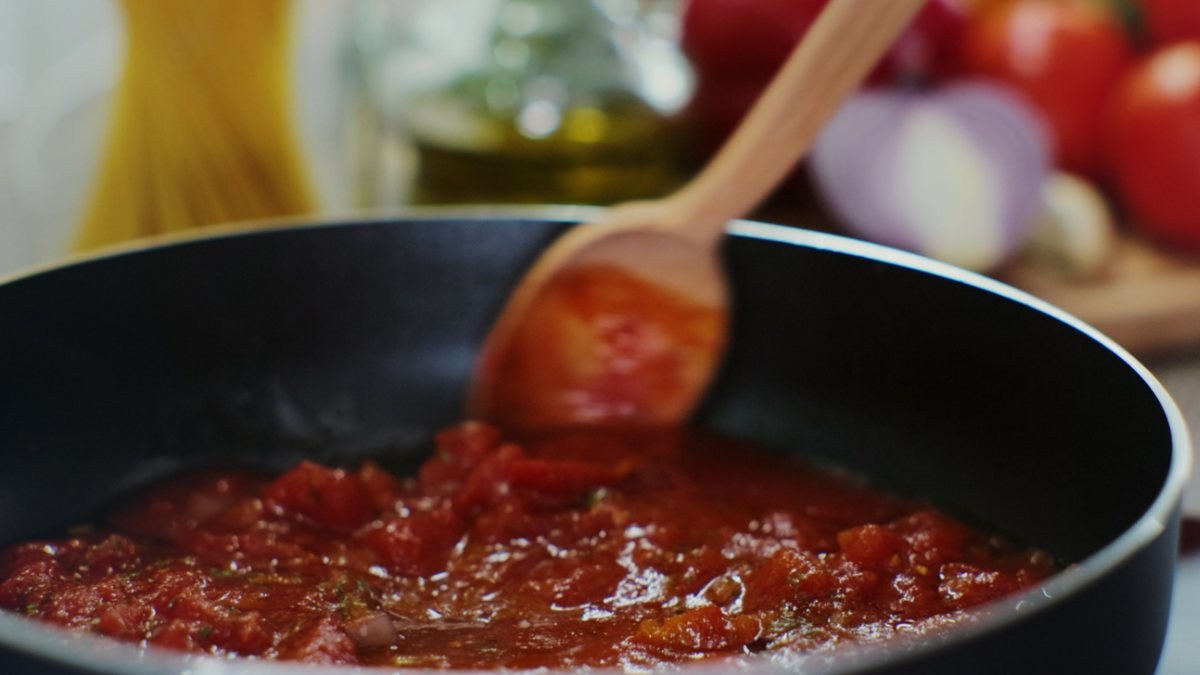
A tip has been circulating since the end of August in the press: for a less acidic tomato sauce, you should not use sugar but three cloves of garlic and 150 ml of olive oil. The described method holds up in the kitchen, but it is presented as a joint declaration by Ferran Adrià and Samantha Vallejo-Nágera, which does not exist in any source. Here is what is actually documented.
A pinch of sugar in tomato sauce is a generational reflex. Since August 25, a series of Spanish articles, then Latin American and Brazilian ones, claim that one should abandon it in favor of a sofrito of garlic, onion and olive oil, with a long cooking. The method is coherent. Its attribution, however, deserves to be clarified.
What sugar actually does
Sugar does not neutralize the acidity of a preparation. It does not modify its pH. What it changes is perception: the sweet sensation dampens the acidic sensation in the mouth, without the sauce having become less acidic in reality. In other words, the gesture corrects a symptom.
The alternative path relies on two levers. First the onion, slowly cooked over low heat until its own sugars begin to caramelize, which brings a sweetness that comes from the food itself rather than from an addition. Then the time: a long cooking at very low heat makes water evaporate, concentrates the flavors and rounds the whole. The published versions mention 50 to 60 minutes, until a reduction of about a third of the starting volume.
What Ferran Adrià actually said
The Catalan chef, born in 1962 in L’Hospitalet de Llobregat, published in 2011 La comida de la familia (RBA ; The Family Meal at Phaidon), a collection of 31 complete menus that were served to the staff of elBulli, up to 75 people per day. It is in this domestic register that the basic recipes attributed to him today sit.
Regarding the precision of quantities, there is an authentic statement, made on the Col·lapse program of the Catalan channel TV3 and reproduced identically by several Spanish media. Translated from Spanish:
When people bake, they always weigh the ingredients. When they cook savory, they don’t. And I don’t know why. A sofrito is not just one onion and two tomatoes, it’s 100 grams of onion and 80 grams of tomato.
Meanwhile, Samantha Vallejo-Nágera, a judge on MasterChef España, is associated with the addition of 50 ml of white wine to the sofrito, once the onion and garlic have melted and before the tomatoes are added, the time for the alcohol to evaporate.
A quote that doesn’t exist, numbers that vary
The sentence put in quotes in the circulating headlines was not spoken by either. The Spanish article at the origin of the wave, published on August 25 by El Español and signed by Cintia de la Paz, contains no direct quotation from Adrià or Vallejo-Nágera. The two cooks have never spoken together on the subject. The Brazilian version published the next day kept the title as is.
The quantities also vary from version to version. The same media had published in December 2025 an article attributing to Adrià 120 ml of oil for 350 grams of tomatoes. The August 2026 one advances 150 ml for 300 grams. More embarrassing: the December article, titled about the absence of sugar, lists “1 pinch of sugar (optional)” in its own ingredients list.
What remains is the substance: a sofrito guided without hurry, a defined amount of olive oil, about an hour of cooking on low heat and salt adjusted at the end of cooking, when the water has reduced and the flavors are concentrated. It is the technique that does the job, not the miracle ingredient.
