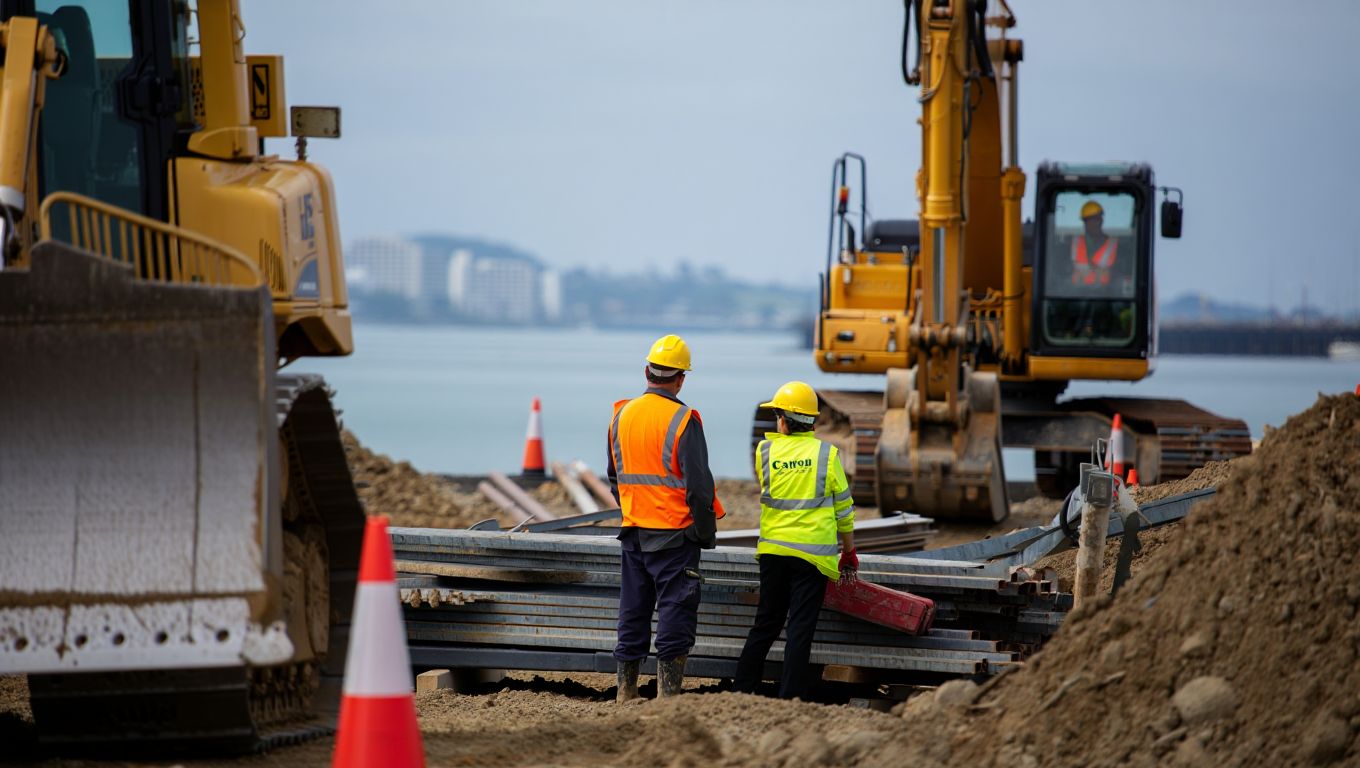
Work has officially broken ground on Tauranga’s harbourside renewal, a project years in the making and rich with local expectation. Excavators rumbled to life at first light, but the strongest signal was softer: a dawn gathering, a shared kai, and a promise that this stretch of shoreline will belong, again, to people as much as to passing tides.
In a city that has grown up fast, the waterfront has often felt like a missed opportunity. Now, with fences up and crews in high-vis moving purposefully, the vision is shifting from artist’s render to tangible change—one pile, one board, one tree at a time.
What’s starting now
The early works focus on foundations and resilience. Engineers are reinforcing the seawall, raising key sections to address storm surges and future sea-level rise. Utility teams are upgrading stormwater and power connections beneath the esplanade to avoid digging up new public spaces later.
At the same time, crews are preparing the footprint for a new harbour-edge promenade, setting out anchor points for shade structures, play elements, and waterside seating. Planting beds—designed with salt-tolerant, native species—are mapped, not yet green but ready to receive thousands of seedlings next winter.
To keep the city centre ticking, heavy construction is being sequenced outside peak trading hours wherever feasible. Wayfinding signs funnel pedestrians safely around works, and pop-up crossings maintain access to the shops and cafés that give the city heart.
- Phase one essentials: seawall strengthening, boardwalk foundations, utility upgrades, temporary access routes, and native-plant nursery preparation.
Why it matters
“Public space is our city’s living room,” said the project director. “When we invest in it, we invest in belonging, in small business, and in the stories we tell about ourselves.”
Local retailers have already noticed more lunchtime foot traffic. “People are curious,” a café owner joked. “They come for the concrete pours and stay for the cappuccino.”
Cultural threads are woven through the design. A kaumātua from a local iwi described the waterfront as “a threshold where whakapapa meets water,” urging that narratives be embedded in stonework, signage, and artwork—not as decoration, but as orientation.
Environmental gains are part of the promise. New intertidal habitat pockets and eelgrass trials, paired with more permeable surfaces, should soften the hard edge of the quay and improve harbour health over time.
How it compares to the past
Below is a snapshot of the shift from a car-dominated edge to a people-first waterfront.
| Aspect | Before | Emerging Waterfront |
|---|---|---|
| Public access | Fragmented paths, frequent pinch points | Continuous, step-free promenade with generous widths |
| Open space | Hard paving, limited shade | Tiered lawns, coastal planting, shade canopies |
| Events | Infrequent pop-ups, ad hoc power | Purpose-built event nodes with integrated power and lighting |
| Ecology | Hard seawall, little habitat | Terraced edge, native plantings, habitat pockets |
| Transport | On-street parking priority | Walk, cycle, and micro-mobility priority; managed parking |
| Climate resilience | Low-lying, exposed to surge | Raised thresholds, resilient materials, floodable zones |
Timeline and budget at a glance
Construction will move in waves. The first visible upgrades run through the cooler months when pedestrian numbers dip, minimizing disruption. A mid-project opening will unlock part of the promenade for public use while crews complete the next sections. Final surfacing and planting will land at the end, timed to suit seasonal growth.
Funding spans multiple years and sources—a council allocation, matched contributions, and targeted grants. Officials are keeping a tight watch on materials inflation, using staged procurement and local fabrication to hold costs. It’s a multi‑million‑dollar commitment with city-changing intent.
Voices from the waterfront
“Kids will be able to skim stones, not just stare over a rail,” said a secondary school teacher on a lunchtime walk. “That’s how you build affection for a place.”
A marine scientist volunteering on the habitat trials sounded a note of optimism and caution: “Design can invite life back, but it takes patience. The harbour works on tidal time, not project schedules.”
And from a nearby resident: “I used to cut through the carparks and leave. I want to linger here. That’s new.”
Risks and how they’ll be managed
No waterfront build is simple. Ground conditions can surprise, especially along older seawall sections. The team has staged geotechnical probes and allowed contingency, so redesigns can be absorbed without derailing momentum. Climate volatility is another pressure: plans include temporary cofferdams and flexible programming to shuffle activities around storm windows.
Supply chains remain tight. To reduce risk, the project is standardizing certain parts—handrails, seating modules—so they can be fabricated locally and installed as kits. Meanwhile, a live dashboard will publish noise windows, detours, and progress markers so residents aren’t left guessing.
What visitors can expect
Even before the last paving stone is laid, the experience will change. Sightlines to the harbour will open. Temporary art and storytelling panels will trace the area’s layered histories. Food trucks and small performances will test event spaces before permanent fixtures arrive.
When complete, the waterfront will feel more like a threshold than a boundary—somewhere to meet, meander, or simply pause with the breeze. Think soft dune-like planting, tactile timber underfoot, and evening light washing across the water. The city’s edge, reimagined not as a back fence but a front porch, ready to welcome anyone drawn to the shimmer of the harbour.
