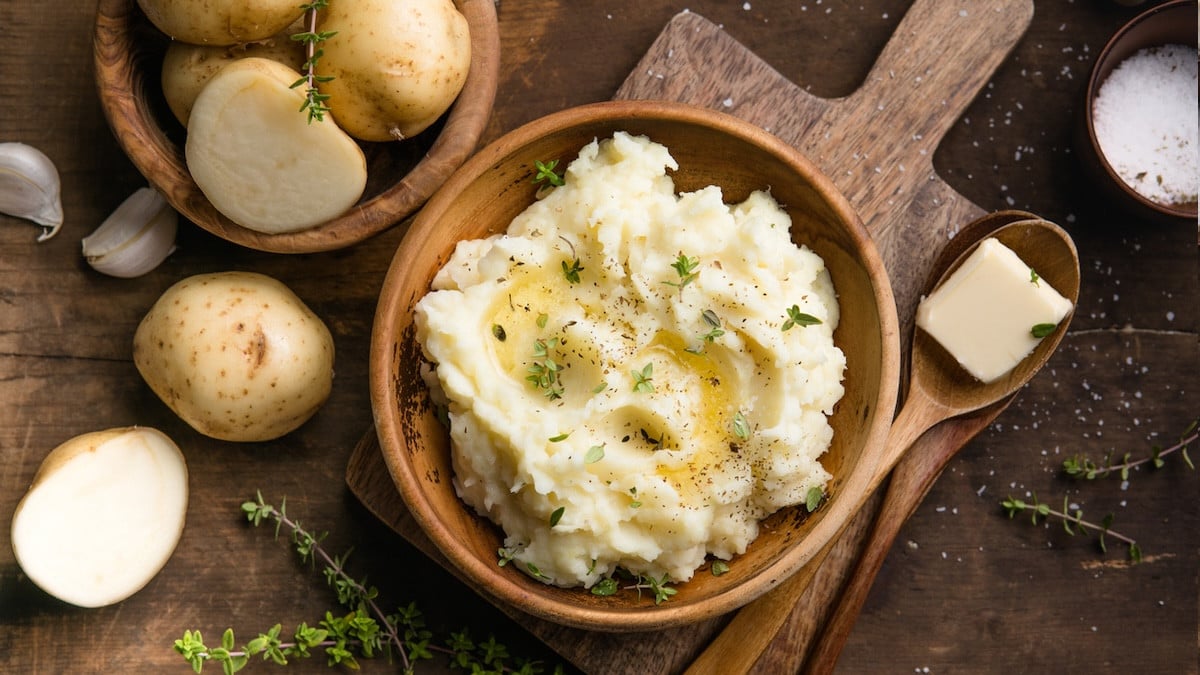
Mashed potatoes, without a doubt, are the ultimate comfort dish. Simple, economical, universal, and yet so often botched. Too runny or too dense, bland… Philippe Etchebest, Michelin-starred chef, Meilleur Ouvrier de France and an indispensable figure in French gastronomy, has decided to share his secrets to make it a dish worthy of a fine restaurant. His trick? The cooking of the potatoes, much more important than you might think.
Forget boiling: switch to the oven!
If there is one piece of advice to remember from chef Philippe Etchebest, it is this: cook the potatoes in the oven and not in boiling water. Contrary to popular belief, boiling potatoes will dilute their aromas and soak their flesh with water, which will harm the flavor and texture of your purée in the end.
Roasting the potatoes in the oven at 200°C will concentrate their natural sugars, which caramelize slightly and develop a subtle, deep flavor. The result? A purée with a rich taste and a soft, indulgent aroma that boiling water simply cannot offer. To try it is to adopt it!
The chef’s trick to know: a bed of coarse salt
To succeed with this oven cooking, Philippe Etchebest places the whole, unpeeled potatoes on a bed of coarse salt. This technique serves a double purpose: stabilizing the potatoes to prevent them from rolling and burning, and above all, slowly drawing out their natural moisture for a flesh that is much more flavor-concentrated. As for the cooking, count about an hour and a half. As for the salt, it can be reused for other cooking; nothing goes to waste!
For a successful purée, cook your potatoes in the oven on a bed of coarse salt! Credit: iStock
Choosing the right potato variety
Bintje, Charlotte, Ratte, Roseval, Amandine, Monalisa… There are more than 3000 varieties of potatoes around the world. So even before you preheat your oven, it all begins with making the right choice regarding the potato you will use for your purée. The Michelin-starred chef recommends floury varieties such as Bintje, Agria or Manon. Rich in starch, they will absorb the butter and milk perfectly for a light and creamy texture in the end. The varieties with waxy flesh, on the other hand, should be avoided as they will yield a grainier and denser purée.
Now that we have the right base products, we can head to the kitchen! Philippe Etchebest recommends cooking at 200°C for 1 hour (adjustable according to the size of the potato) before peeling them while still hot (with a cloth to avoid burns), because it is very important to work them hot for a perfectly creamy purée.
Masher, fork, or blender? Philippe Etchebest shares his ultimate technique
Once our potatoes are well tender and peeled, we pass them through a potato ricer or mash them with a fork for a smooth texture. No blender, which would make the purée too elastic and sticky! All that remains is to incorporate the butter in cubes and the hot milk gradually.
For 1 kilogram of potatoes, the chef recommends adding 200 g of butter and 20 cl of milk to obtain a truly velvety purée. The final mixture is done in a sauté pan over gentle heat, whisking well to homogenize everything. As for seasoning: salt, pepper, and perhaps a pinch of grated nutmeg to elevate the whole with a refined and warming touch.
For those who love ultra-smooth textures, you can pass the purée through a fine sieve. It promises a finesse worthy of a Michelin-starred restaurant!
Mistakes to never make again
As you’ve understood: even though purée is one of the simplest dishes, you must follow a few golden rules for a perfect result. So let’s recap:
– The cooking is in the oven and not in water;
– Forget the blender and adopt the potato ricer;
– Do not rinse the potatoes after cooking (which is done with the skin on);
– Potatoes should be worked hot and NEVER cold;
– Choose a floury potato variety.
By following all these chef’s tips, you can never go wrong with your purée.
