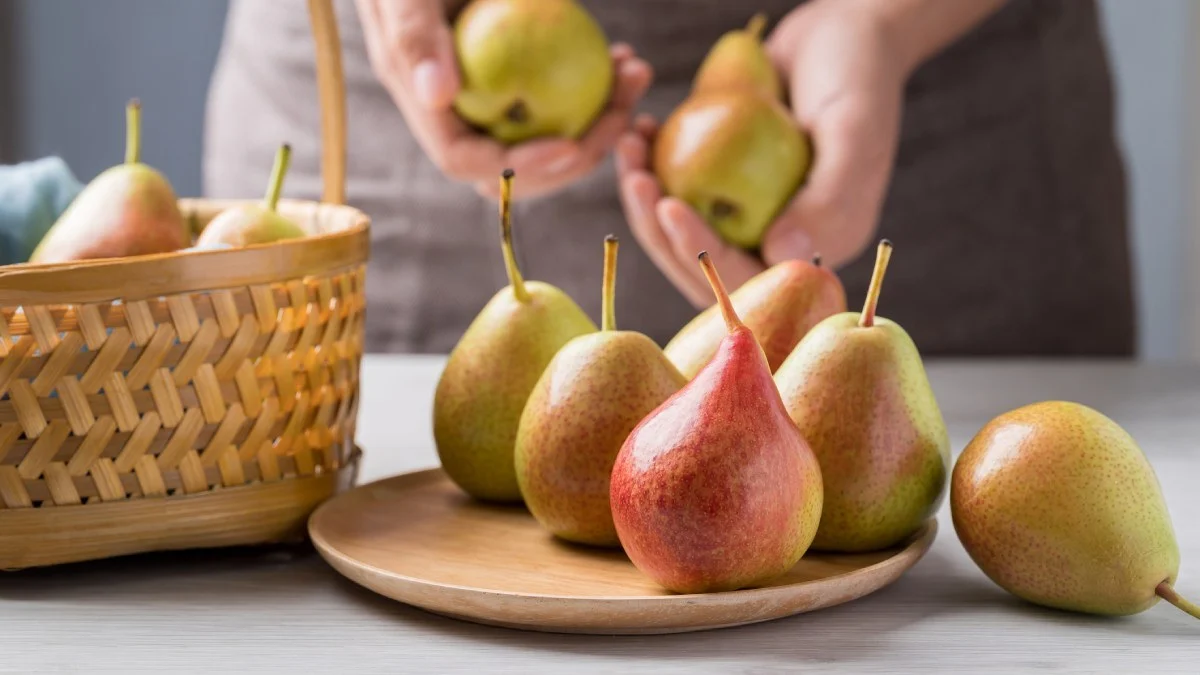
A pear that resists when you bite into it, instead of melting in your mouth, another that is already too soft when you cut into it… In the fruit section, it’s hard to know which one to put in your cart. Three benchmarks can help you choose better, provided you look in the right places and take into account when you plan to eat it.
In front of the display, the temptation to pick the prettiest fruits is strong. A well-colored skin, a generous shape, and the matter seems settled. But appearance doesn’t tell the whole story: a pear that is still green can be ready to eat, while a firm fruit is not necessarily a bad purchase.
The right question, then, arises even before you reach out: are these pears meant for tonight’s dessert or for the coming days? The choice won’t be exactly the same. Here is how to sort them without squeezing every fruit from the crate.
1. Look at the skin and the stem before choosing
Start by examining the fruit from several angles. In its tips for choosing pears, Interfel recommends taut skin, with no marks from impacts or bruising. The stem, this small stalk at the top, should be present and well attached.
The aim is not to find a prize pear. It’s mainly to spot damage: a dent, a bruise, or a clearly crushed area should draw your attention. Take time to also look at the part that rested against the other fruits, less visible at first glance.
Be careful, however, not to confuse the natural color of the skin with a defect. USA Pears, the organization representing producers in the Northwest United States, notes that Bosc naturally has a cinnamon-brown skin, sometimes largely covered with russeting marks. This aspect does not, on its own, affect the quality of the fruit.
A brown pear is therefore not necessarily spoiled, just as a perfectly uniform pear is not necessarily ripe. If you encounter a variety you don’t know, ask its name of the seller. It helps avoid discarding a good fruit simply because it doesn’t look like the one you usually buy.
2. Gently test the firmness near the stem
To know if a pear is ready to eat, you don’t need to press on its entire surface. The useful gesture is near the peduncle, in the narrow part of the fruit called the neck. Apply a very light pressure with your thumb: if the flesh yields gently, that’s a sign of ripeness.
This test is recommended by specialists at Oregon State University and by USA Pears. It provides a more useful reference point than color alone. Some varieties change little in appearance as they ripen: waiting for them to turn yellow may cause you to miss the right moment.
The pressure should remain light. It isn’t about pushing with the thumb or leaving a mark. If the fruit resists, there’s no need to press further: choose another for immediate consumption, or keep this one to let it continue to ripen at home.
The variety does bring an important nuance. The Bosc, whose flesh is denser, can be pleasant to eat while remaining relatively firm. Its neck yields less readily than that of other pears. Concorde, too, can be enjoyed with a texture still crisp, depending on preferences.
Another special case: Asian pears, often called nashi. They stay firm when ripe. Oregon State University’s Extension Service notes that you should not wait for them to soften like European pears. The same degree of firmness does not mean the same thing for all fruits.
3. Choose the firmness according to the day you’ll eat them
Are you preparing a dessert for tonight? Look for a pear whose neck already shows a slight give. Are you shopping for several days? Fruit that is still firm can be a wise choice. Interfel notes that winter pears can be bought firm and continue to ripen at home.
This is a particularity to know: European pears are generally harvested before reaching their eating maturity. A firm pear on the stall does not necessarily mean it was picked “too early.” Oregon State University specialists clearly distinguish the harvest stage from the stage at which the fruit becomes pleasant to eat.
In practice, you can spread out your purchases: a few pears ready to eat, then others less advanced. Simply tell the greengrocer what you’re looking for: “for tonight” is a more useful indication than “well-ripe” when you’re also buying fruit for the week.
Do not, however, count on an identical ripening duration for the entire basket. Variety, the stage at the time of purchase, and storage conditions all play a role. Two pears bought together will not necessarily be ready on the same day.
4. At home, manage ripening without forgetting the fruits
For commercially sold pears that are still firm, let ripening continue at room temperature and check their progress daily. This is the advice given in USA Pears’ practical sheet dedicated to ripening and storage. Re-do the neck test, always without forcing.
Once the fruits are ripe, the refrigerator helps slow their progression. USA Pears recommends consuming them within about three to five days. This guideline isn’t a guarantee: a pear that is already very advanced or damaged will not store as well as a fruit just reached maturity.
These tips apply to pears bought to be eaten. If you harvest those from your garden, the process may be different: some varieties require a cold period after harvest to mature properly. It’s better to learn about the variety rather than leaving the entire harvest in the kitchen.
5. Small gestures to avoid wasting a good purchase
The selection doesn’t stop at the stall. Pears bruise easily: in the shopping bag, give them a place where they won’t be crushed by jars or other heavy purchases. Handle them with the same care when putting them away.
When serving them, rinse under running water, even if you plan to peel them. Oregon State University recommends washing them just before consumption. Also wait until the last moment to peel or cut them, to limit browning of the flesh exposed to air.
And if you prefer a firmer texture, there’s no need to systematically seek a very melting pear: the variety and your tastes also matter. The right purchase is the one that matches the intended use, whether to bite into the fruit, serve it in slices, or cook it.
For your next shopping trips, keep in mind three checks: the condition of the skin, the firmness near the stem, and the day you plan to taste them. If you’re unsure when considering summer fruits, you’ll find our tips for choosing a ripe and sweet melon. Each fruit has its clues: for pears, you first look near the stem.
