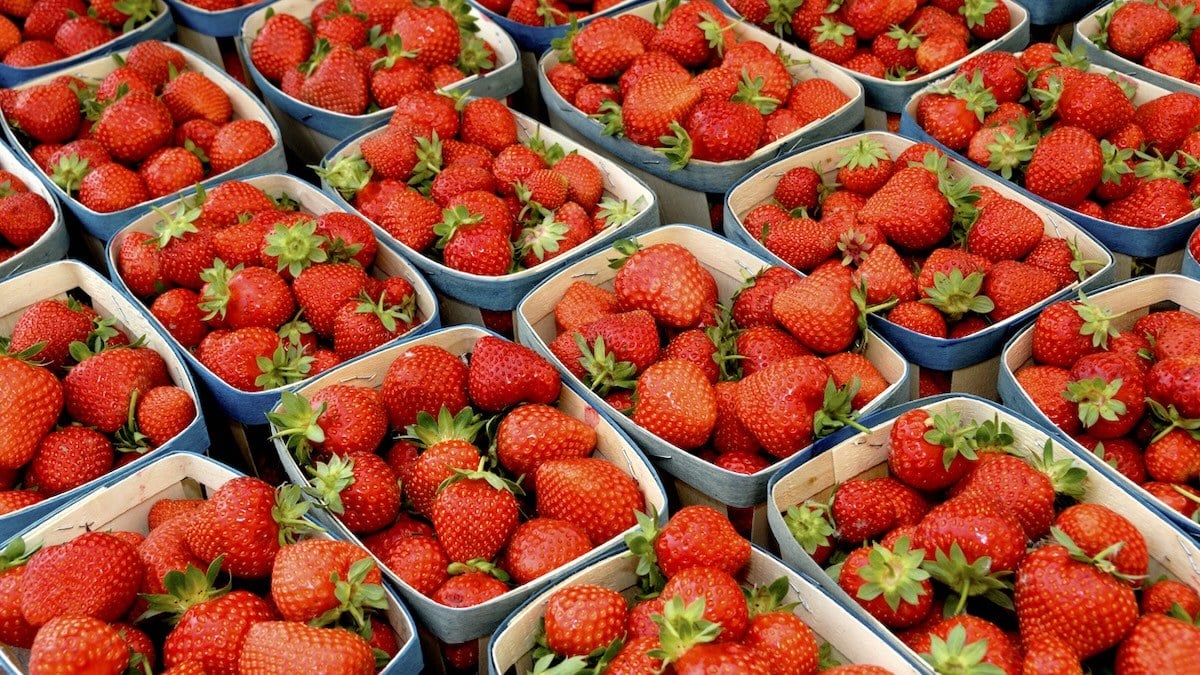
It’s one of the great summer frustrations: you come back from the market with a tray of beautiful, fragrant strawberries, as red as you could wish, and two days later half of them are covered in mold. As the youngsters say: “the seum.” It only takes one damaged strawberry to contaminate all its neighbors at a disconcerting speed… Yet, the farmers who store tons of strawberries each season don’t throw away half of their harvest. So how do they do it? Their secret lies in an ingredient you may already have in your cupboard (if not, we strongly recommend going to buy it quickly).
Why do strawberries mold so quickly?
The strawberry is one of the most perishable fruits there is, and it’s no accident. Its thin, porous skin offers virtually no protection against external microorganisms. The molds you may observe are actually already present on the strawberries at purchase in the form of invisible spores to the naked eye. And if you’re wondering which fungus is the main cause of this “gray mold,” blame Botrytis cinerea.
These spores germinate as soon as conditions are favorable, and the strawberry brings together the three worst: humidity, heat, and the presence of sugar. The slightest micro-damage to the skin of this juicy fruit, caused by handling or transport, is enough to trigger the mold process. Knowing that the spores spread by direct contact, a contaminated strawberry rapidly transmits its mold to all those around it in the basket. But rest assured, it is absolutely possible to limit the damage, and with a little magical ingredient you probably haven’t thought of!
The Vinegar Bath: the producers’ technique to eradicate the spores
The solution used by professionals before storage is remarkably simple. It involves soaking the strawberries in a vinegar-water bath whose acidity neutralizes surface mold spores before they have time to develop. The recipe is precise: mix one part white vinegar to eight parts cold water. Submerge the strawberries whole, unstemmed and not washed beforehand, for about five minutes. The acidity of the vinegar will thus act as a natural antifungal without altering the fruit’s taste, provided you follow the dosages carefully.
After this dipping time, drain the strawberries carefully and dry them with paper towels or a clean cotton cloth. This is the most important step! Any trace of residual moisture would promote exactly what you’re trying to avoid, namely the development of the mold Botrytis cinerea.
Then store the thoroughly dry strawberries in a container lined with paper towels in a single layer if possible, and place them in the refrigerator. Some farmers even recommend adding a sheet of paper towel between each layer to absorb excess moisture over the days. Result? Perfect strawberries for 8 to 10 days without mold!
Does vinegar give the strawberries an off taste?
This is the question everyone asks before adopting this method. And the answer is obviously NO! Well, as long as you respect the dosage and the dipping time. Five minutes in a sufficiently diluted bath leave no perceptible vinegar taste on the palate. The delicate, fruity aromas of the strawberry are fully preserved. Hundreds of home tests confirm it, rest assured. Strawberries treated with the vinegar bath taste exactly like fresh strawberries of the day. The only difference is that they stay fresh much longer!
The mold-prevention protocol in 4 steps, in summary
We’ll recapitulate one last time to help you keep your strawberries for 8 to 10 days: first a five-minute vinegar bath as soon as you get home, then careful drying, a careful sorting of damaged berries, and storage in a box lined with paper towels in the fridge. These four simple steps will truly transform the lifespan of your favorite summer fruit (and perhaps of the year)!
