Have you ever spent more than five minutes folding, cutting, and trying to keep a stubborn sheet of parchment paper in place while your dough patiently waits beside it? We’ve all been there at least once in the kitchen. Yet there are some very simple tricks to put an end to this problem once and for all. Thibaut Spiwack, a Michelin-starred chef and former Top Chef contestant, recently shared them in a video, and you’ll see, it’s going to change your life. Here we go!
Why parchment paper is indispensable in pastry
Before talking technique, let’s remind ourselves why we often need it. Parchment paper (also called baking paper) is a real ally in the kitchen, especially in pastry. It prevents preparations from sticking to a sheet pan or a mold, which considerably eases the unmolding of your cakes and other treats. It also saves you from having to grease molds every time you use them.
The problem? Placing a sheet of parchment at the bottom of a pan isn’t easy. The edges lift, the paper slips, the dough sneaks underneath… In short, it’s a struggle and unmolding can quickly become chaotic. All because the folding wasn’t adapted to the shape of the pan. But don’t despair: the Michelin-starred chef who passed through the kitchens of Top Chef season 13, Thibaut Spiwack, shared a short tutorial video to properly install your parchment in all your molds.
Read also: Wilted salad in 2 days in the fridge: the farmers’ method to keep it for 15 days
Loaf pan: the corner incision that changes everything
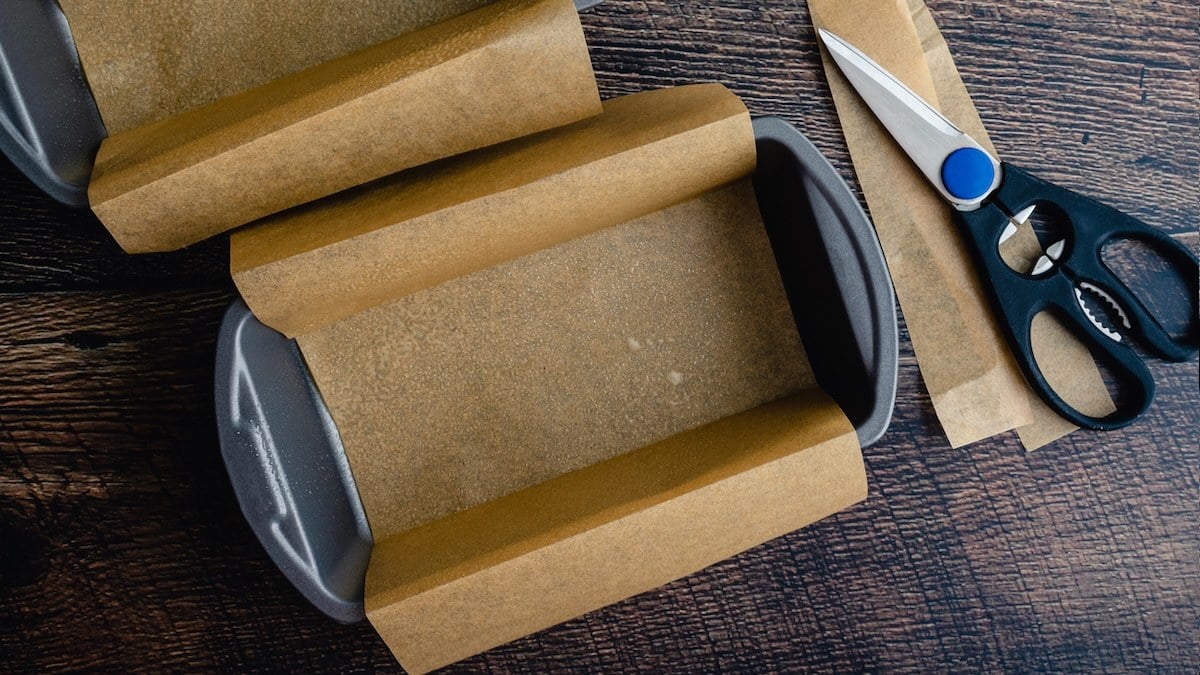
Let’s start with the rectangular loaf pan. Most people will cut out a rectangle and try to make it hold in place. A lot of hope for little success…
The right method is to measure the inner dimensions of the mold and then make a small notch in each corner of the sheet. These cuts allow the edges to rise neatly without creating “bad folds” or leaving areas uncovered. The paper thus fits perfectly against the sides of the pan, and unmolding becomes child’s play—just grab the overhanging edges and lift gently.
Round mold: the express origami technique
For round cakes, the rectangular sheet is clearly not the right method. After all, you don’t fit squares into circles, and vice versa… So here’s how to obtain a perfect circle without doing geometric calculations or pulling out a compass.
First fold your sheet into a square, then again into a triangle. Starting from the central point, cut off the rounded end to form an arc, and finish with a small incision at the center of your fold (we’ve got the video tutorial right after, don’t worry). When you unfold your sheet, you’ll have a perfect disk that will fit the bottom of the pan without shifting. Quick, precise, and hassle-free.
Muffin tins: folding homemade liners
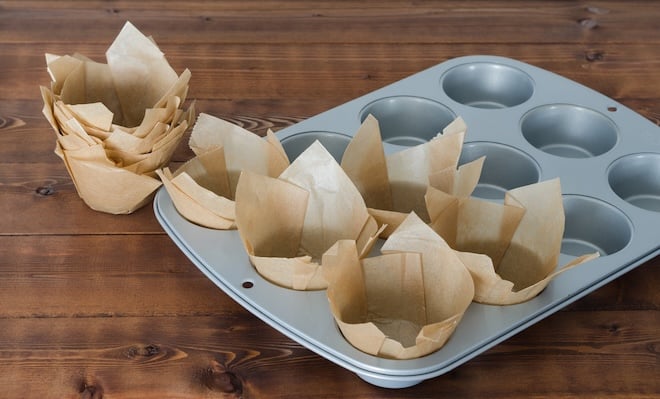
It’s probably the most impressive technique of the three, and yet it doesn’t require any special equipment! Just a cup or a straight-sided glass to serve as a template.
Cut a square of parchment paper and fold it into four. Turn your cup upside down and place the folded square over it. Then fold the paper’s four sides down, all oriented in the same direction, as if forming the folds of a liner (again, you’ll see the example in the video that follows). Press firmly to secure the folds, or use another cup to help mark the shape well. All that remains is to slide your homemade liners into the muffin-tin cavities! Very handy when you’ve forgotten to buy paper liners at the supermarket.
View this post on InstagramA post shared by Thibaut Spiwack (@thibautspiwack)
What if we don’t have parchment paper anymore?
Don’t panic! You don’t necessarily need parchment paper to bake your cakes. You can still butter and lightly flour your mold instead of using parchment, which works just as well. Alternatively, you can use silicone molds without adding anything. In all cases, you should always wait for the cake to cool slightly before unmolding to avoid it breaking under the heat.
The writer’s bonus technique
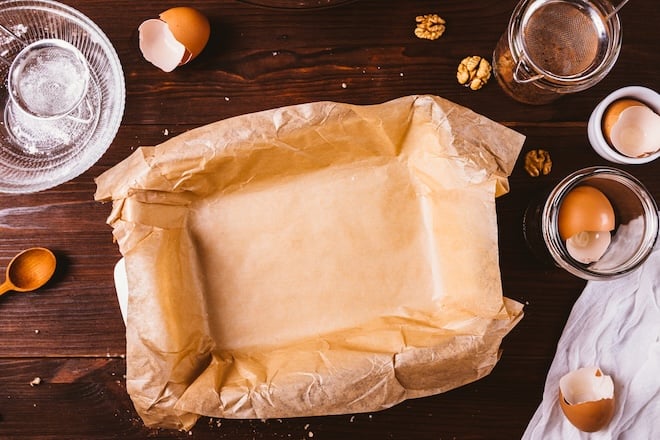
If you don’t have scissors at hand and you need to keep parchment in a mold, there is one last ultimate technique: crumpling! It’s very simple: cut a sheet of parchment and crumple it in your hands, then unfold it. It won’t be perfectly smooth but at least it won’t slide around in the mold!
