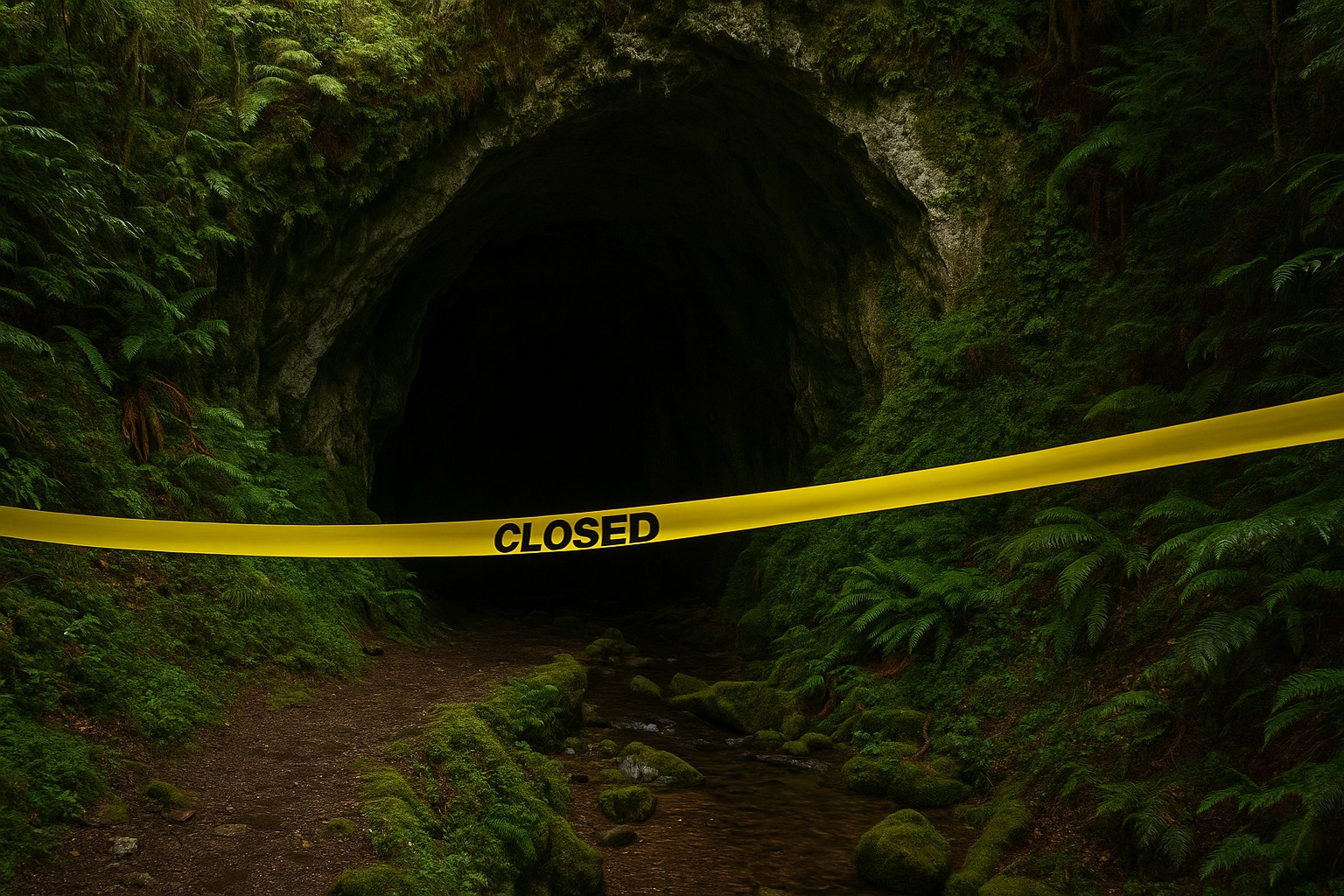
A quiet closure in King Country
On the western fringe of Te Kūiti, a remote karst network has been abruptly shuttered.
Officials at the Department of Conservation — the DOC — say it is a routine measure.
Locals, researchers, and seasoned cavers say the timing is strange, and the explanation thin.
The cave few knew, and fewer could enter
Among experienced crews it is called Ngāwhāri Hollow, a limestone maze with still pools and delicate strata.
It is not a ticketed site, not a glossy brochure, and not a place for casual tourists.
For years, supervised groups and university teams stepped carefully along fossil-rich layers.
A sudden gate, and colder air
Last week a new steel grate appeared at the entrance, locked and freshly welded.
Warning boards now say “Restricted Area — Entry Prohibited Until Further Notice.”
The official line cites “internal monitoring” and a “structural review,” with no date for reopening.
Permits pulled and phones quiet
Cavers describe permits canceled with days to spare, itineraries upended without detail.
One trip leader told me he received a brief email, then a second note asking not to reapply.
He sounded less angry than wary, as if the silence spoke a louder warning.
“Three days before we were due to go in, they canceled our permit,” said Callum, a university outdoor program coordinator. “No reason was given, just that the site was no longer available.”
Signs that something shifted underground
Those who visited recently noticed a sharper-than-usual drop in cave temperature, a breath that felt newly cold.
Condensation pooled along narrow passages, beading on formations that usually stay dry.
Most unsettling were clean, linear fractures scoring the wall, not the rounded weathering cavers expect.
Some suspect a breach into a second chamber, a hollow that changes airflow and load.
Others speak of artifacts or taonga — something culturally significant, and deeply sensitive.
A few whisper about bones, a word that arrives with both gravity and care.
Whānau knowledge and withheld answers
Local iwi have historically partnered on access, yet now maintain a deliberate silence.
One kaumātua offered only a measured phrase: “There are things below that are not for everyone to see.”
In Aotearoa, that sentence carries weight, and it asks for respect.
Theories that multiply in the dark
With no detailed briefing, speculation moves faster than underground streams.
Some of the most repeated possibilities include:
- An undisclosed scientific discovery requiring controlled study
- Instability triggered by a new void, increasing collapse risk
- Hazardous gas pockets — low oxygen or rising CO₂
- Evidence of unmarked burials, demanding cultural protection
- Sensitive wildlife or microbe colonies, vulnerable to visitor impact
Each theory has a ring of plausibility, and none can be easily verified.
Safety, secrecy, and the public’s stake
Caves are unforgiving places, and caution is rarely a bad policy.
Yet a total closure without clear criteria invites more doubt than trust.
When a site holds scientific or cultural value, the community asks for careful process.
DOC’s wording feels clinically vague, the kind of phrasing meant to calm concern while revealing nothing.
If the risk is geotechnical, numbers and thresholds can be shared without exposing locations.
If the risk is cultural, a general statement can honor protocol and set expectations.
What the rock remembers
Ngāwhāri Hollow is a ledger of water, time, and fragile history.
Its sub-fossil deposits are among the island’s most intact, a rare scientific archive.
Locking it down may well be the right call, but opacity corrodes public confidence.
One veteran caver put it bluntly: “You don’t weld a gate on a healthy cave unless something changed — either in the rock or in what people have found.”
That line, like a faint drip in the dark, is hard to ignore.
Where this goes from here
Right now the site is closed indefinitely, with permits suspended across all groups.
No rāhui has been publicly declared, and no hazard bulletin has been issued.
Between those absences and a newly sealed entrance, the story feels carefully unfinished.
If there is risk, say so.
If there is discovery, protect it and say that.
Until then, the cave holds its own counsel, and the region waits for a clearer truth.
