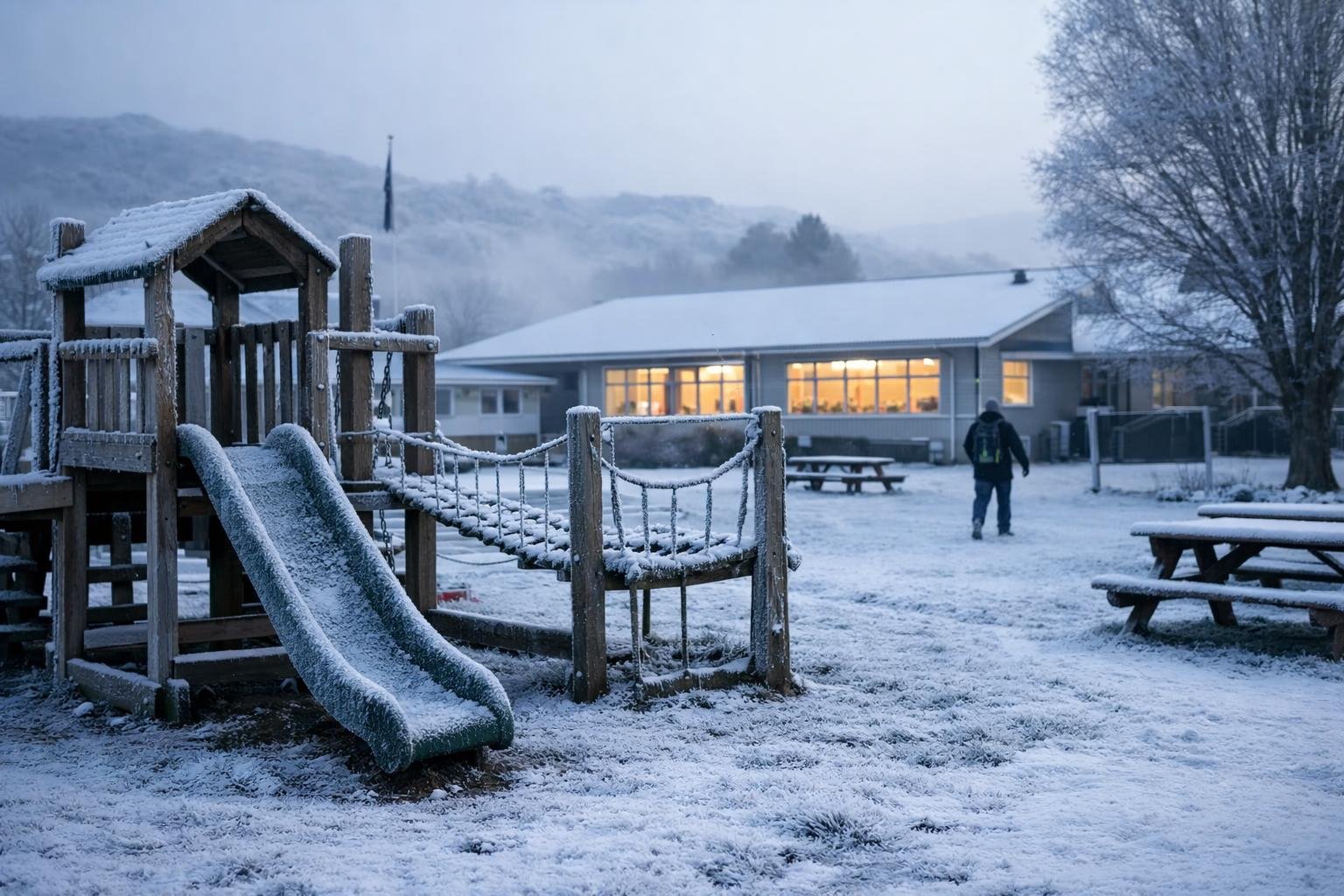
A blast of polar air is rumbling up the South Island, promising glittering frost, a bite of -10°C windchill in exposed spots, and the kind of dawn that turns puddles to glass. Otago is bracing for it. Families are laying out thermals. Principals are staring at bus route maps.
The big question is less about classrooms than about the roads between homes and those classrooms. With black ice a real threat after clear skies overnight, Monday morning won’t be business as usual—no matter what the bell schedule says.
Officials are signalling caution, but also a determination to keep learning on track. That mix—safety first, continuity close behind—will shape what actually happens at first light.
Forecast at a glance
Meteorologists expect a sharply colder pocket settling over inland valleys, with urban coastal areas a touch milder but still frozen underfoot. Even if snowfall proves patchy, any moisture left on surfaces will refreeze hard before dawn.
Temperatures are one piece; surface conditions are another. “A clear, calm freeze after weekend showers is the perfect recipe for ice,” said one Otago road contractor. “If grit freezes over, even treated corners can surprise you.”
The plain reality: it might feel sunny by late morning, but the danger window for buses and early commuters sits squarely between 6 and 9 a.m., right when decisions bite.
How different parts of Otago might fare
| Area | Forecast low (°C) | Snow level (m) | Bus route risk | Planning stance (indicative) |
|---|---|---|---|---|
| Dunedin (urban) | -2 to -4 | 300–400 | Moderate | Open, possible late start |
| Mosgiel/Taieri | -5 to -7 | 200–300 | High | Delayed start under review |
| Central Otago | -6 to -9 | 200–300 | Very High | Delays or limited closures |
| Queenstown-Lakes | -4 to -7 | 300–500 | High | Staggered buses likely |
| Clutha District | -3 to -6 | 200–300 | High | Mixed: rural delays possible |
| Waitaki (south) | -3 to -5 | 300–400 | Moderate–High | Open with caution |
These are scenario-based planning notes, not official notices. Families should check their school’s channels before leaving home.
What schools are weighing up
Contrary to myth, there isn’t a single, region-wide switch. Boards and principals work from a shared playbook that puts transport safety at the top, followed by site readiness: heating systems, icy steps, and whether staff can reach the gates.
“Safety will always come first,” said a South Otago principal. “If buses can’t safely reach rural stops by dawn, we’re not sending them.”
Other factors matter too. Older buildings can struggle to hold heat in severe cold; burst pipes are a risk after multi-night freezes. Power reliability on frosty mornings sometimes dips under peak load. And for secondary schools with exams or assessments, leaders will look hard at hybrid options—pushing start times back or moving specific classes online.
Parents’ voices carry as well. “I’m packing extra layers and planning a later drop-off if they allow it,” one Dunedin parent said. “I’d rather be slow than sorry.”
Transport is the hinge
Buses are the lever that matters most for rural and semi-rural communities. Even when campuses are safe by mid-morning, shaded stretches can stay slick long after sunrise.
Operators typically run early recon drives. If wheel spin or untreated frost shows up in the usual black spots—bridge decks, south-facing cuttings, hill saddles—expect delayed starts or route cancellations before breakfast. Schools often keep sites open for families who can walk or drive locally, while acknowledging that attendance may be uneven.
For teen drivers, principals will continue to repeat the message: leave the car at home if there’s ice. “If in doubt, don’t,” said a school transport coordinator. “No timetable is worth a skid.”
Quick prep for families
- Layer up (thermal base, mid fleece, windproof shell), plus grippy footwear, hat, and gloves; toss a spare pair of socks in the bag.
What to expect Monday morning
Look for status updates between 6:00 and 7:30 a.m. on official school websites, Facebook pages, and via text or app alerts. Local radio still plays a role, especially for bus notices. If there’s a two-hour delay, it usually means campus gates open on time for supervision, while formal teaching begins later—giving ice a chance to soften and buses to make careful, staggered runs.
Where attendance is difficult, schools may share quick digital packs to keep momentum. Don’t be surprised by flexible marking of rolls; most leaders understand that rural access varies wildly after a hard freeze.
If your route crosses a known ice trap, ask specifically about that segment. A school may be “open,” but an individual bus leg could be suspended.
Staying flexible in a freeze
Otago knows winter. Communities have long memories for cold snaps, and the muscle memory kicks in: thermoses on dashboards, sand in the boot, phone trees lighting up before dawn. Monday may bring crisp blue skies and glittering verges—and still demand careful choices.
The bottom line: expect nuanced calls, neighborhood by neighborhood. Keep an eye on official channels, leave extra time, and prioritize the simple rule that matters more than any bell time—get there safely, or not at all.
