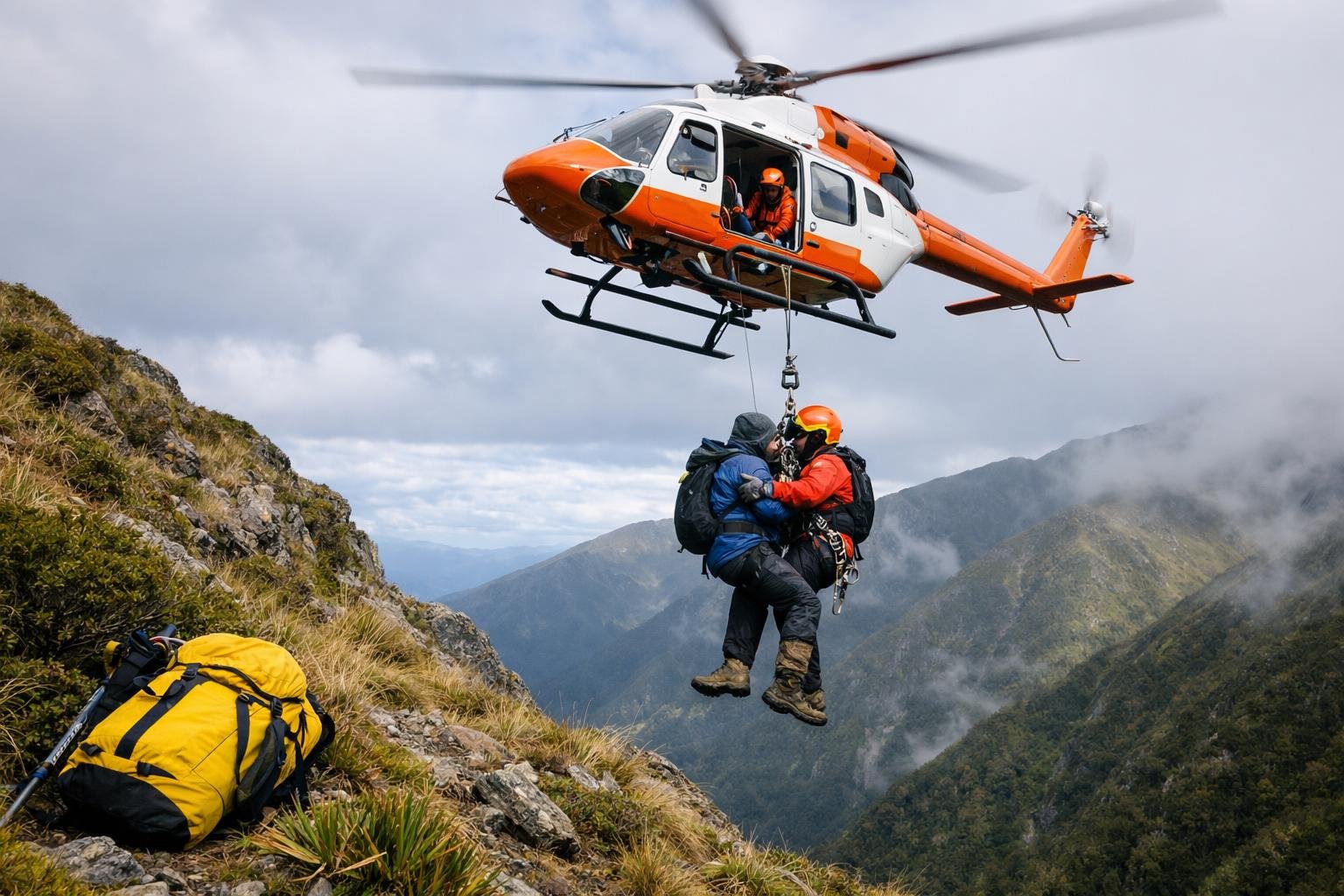
Winds howled across the ridgelines as a solo tramper hunkered down beneath a battered bivy, counting the hours and praying for a break in the cloud. After two long nights exposed on a high spur of the Tararua Range, the break finally came—in the thump of rotor blades and the swing of a helicopter winch line.
The ordeal on the ridgeline
The tramper set out for what was meant to be a brisk early-spring circuit, a route well-known for its breathtaking views and notorious for rapid weather shifts. Forecasts hinted at deteriorating conditions, but the speed and ferocity of the change caught him out. Gale gusts pushed beyond comfort. Cloud sank, visibility collapsed, and the marked route dissolved into white and grey.
He tried to retreat to the last hut he’d passed. A misstep on slippery scree ended the plan—no major injury, but a painful ankle and a torn gaiter that made forward travel sketchy. With darkness closing in, he made the hard call to shelter in place.
From missing to located
When he failed to check in that evening, family raised the alarm. A coordinated search began at first light, blending ground teams moving in along the spur lines with an airborne sweep during weather windows. For two days, gusts, sleet, and ragged cloud foiled progress. “We knew he was out there and likely sheltering. The challenge was punching through the whiteout safely,” a rescue coordinator said.
When a break finally opened, the chopper moved fast, riding a clear corridor to the high country. A bright panel of emergency foil and a flicker of movement near a tussock bench gave the crew what they needed. The winch operator dropped in, checked the tramper’s condition, and clipped him onto the strop for a short lift into the cabin.
What the terrain demanded
Anyone who’s walked the Tararuas knows the hills don’t negotiate. Knife-edge ridges, abrupt drops, and wind that can strip heat even in summer—this range turns simple miscalculations into cascading risk. Route-finding is intricate in clag; markers disappear in the tussock and the snowgrass. Even huts that feel a stone’s throw away can become unreachable when the wind decides otherwise.
“People underestimate how quickly the wind chill bites up there,” one ground team member noted. “Drain your warmth, sap your judgment, and minutes later you’re on the wrong spur.”
Decisions that made a difference
Though stranded, the tramper stayed methodical. He insulated from the ground with his pack and spare layers, rationed water and food, and used a PLB (Personal Locator Beacon) judiciously—activating it after the second night when the forecast worsened and his ankle swelled.
Small choices mattered:
- He kept a bright thermal blanket visible for aircraft and conserved battery on a small torch for signaling bursts rather than continuous light.
“These are the habits that buy us time,” a crew member said. “Staying put once injured, maximizing contrast for visual search, and keeping warm—they stack the odds.”
Rescue options at a glance
Different rescues call for different tools. Here’s how common approaches stack up in this kind of country:
| Method | Speed to Casualty | Weather Dependence | Terrain Limitations | Typical Use Case |
|---|---|---|---|---|
| Helicopter winch | Fast (minutes–1 hr) | High | Needs hover space, wind cap | Exposed ridgelines, urgent med needs |
| Ground team carry-out | Slow (hours–days) | Low–moderate | Can negotiate dense bush | Poor flying conditions, stable patients |
| Self-evacuation assist | Moderate | Moderate | Requires safe route options | Minor injuries, guided to nearest hut |
On this day, the winch was the only safe bet once the weather blinked.
Voices from the ridge
“I kept telling myself: Don’t wander. Don’t chase the map inside your head,” the tramper said later. “I had shelter, a little food, and a beacon. I just needed patience.”
A rescuer added, “People imagine heroics. Most of the time, it’s patience and process. We wait for the gap. We move when the risk calculus says go.”
As for the helicopter crew: “The first sight of that silver blanket against the tussock—pure relief. It’s the kind of contrast we train our eyes to catch.”
The aftermath and recovery
Back on the ground, paramedics treated mild hypothermia, dehydration, and the swollen ankle. No fractures; a good outcome from a bad spot. Friends who gathered later joked about the “expensive taxi ride,” and the tramper took it with a wry smile: “Worth every cent I didn’t pay.”
He plans to return to the hills—but with a sturdier shelter, renewed respect for shoulder-season forecasts, and a better plan B. “You don’t beat the range,” he said. “You read it.”
Staying safer in the Tararuas
The mountains will always keep the upper hand, but preparation narrows the margin:
- Carry a PLB, insulated sit pad, stormproof layer, and high-contrast signaling gear; set conservative turn-back times and treat marginal forecasts as a stop sign, not a suggestion.
A quiet reminder
Rescues like this are not just stories of skill and luck—they’re stress tests of planning, humility, and the thin line between adventure and misadventure. On a windswept spine of the Tararuas, a handful of good decisions and a timely weather window made all the difference. The range remains, beautiful and blunt, asking the same question it always does: Are you truly ready?
